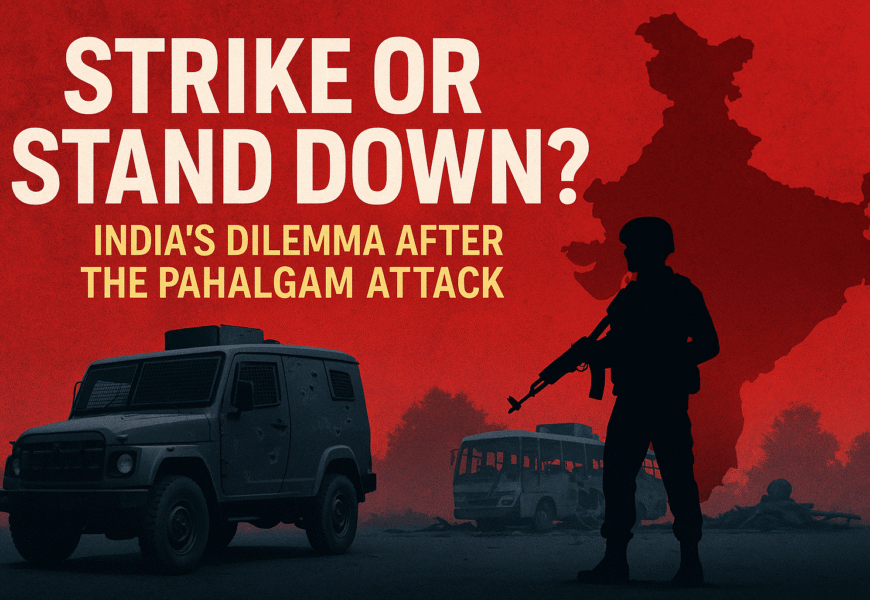
Pahalgam Attack and Regional Security Dynamics
The recent attack in Pahalgam has once again brought the spotlight on the volatile security dynamics between India and Pakistan. As calls for retaliation grow louder within India, questions arise about the feasibility and consequences of a military response, particularly in the context of Pakistan-occupied Kashmir (PoK) and the highly strategic Gilgit-Baltistan region. This area is not just of concern to Pakistan but also to China, owing to the China-Pakistan Economic Corridor (CPEC), a core component of Beijing’s Belt and Road Initiative (BRI).
The Strategic Importance of Gilgit-Baltistan
Gilgit-Baltistan is no longer a forgotten frontier. Strategically nestled between Pakistan, China, and India, the region holds immense geopolitical value. For China, it’s the lifeline of CPEC, a multi-billion dollar infrastructure and energy project connecting China’s Xinjiang province to Pakistan’s Gwadar port. Oil, gas, and commercial trade destined for China pass through this corridor, offering Beijing direct access to the Arabian Sea and bypassing vulnerable maritime chokepoints like the Strait of Malacca.
Recognizing this criticality, China has exerted considerable pressure on Pakistan to regularize the region’s political status. Islamabad, under this influence, has proposed granting constitutional representation to Gilgit-Baltistan, despite its internationally disputed status. This move is not merely symbolic—it’s an attempt to legitimize Chinese economic and military interests in the region.
India’s Military Options and Risks
Any Indian military action in PoK, especially near Gilgit-Baltistan, would have far-reaching consequences. A strike aimed at disrupting terror infrastructure might seem justifiable, but a broader military escalation could inadvertently threaten CPEC. Such an act would draw Beijing into the equation, transforming a bilateral conflict into a trilateral geopolitical flashpoint.
Moreover, Chinese retaliation may not be restricted to the western front. India’s northeast, with its challenging terrain and fragile border infrastructure, could become the next theater of tension. The Doklam standoff of 2017 is a reminder of how quickly friction can spread to other sensitive borders.
Geopolitical Calculations and the U.S. Factor
India’s growing partnership with the United States—particularly in the Indo-Pacific aimed at countering Chinese influence—further complicates matters. Washington may privately welcome any disruption to CPEC as part of its broader containment strategy against China. However, if India were to act in alignment with U.S. interests, it might find itself caught in a proxy chess game between two global giants.
Aligning too closely with the U.S. may enhance India’s strategic stature, but it could also provoke a deeper Sino-Pak response—economically, militarily, and diplomatically. The price of playing Washington’s game could be high, especially if it leads to regional instability, trade disruptions, and possible multi-front conflict.
Retaliating for the Pahalgam attack is a deeply emotional and strategic decision for India. While the desire to punish terror actors is understandable, the complexity of the geopolitical chessboard—featuring China’s stakes in CPEC and the U.S.-China rivalry—demands a calibrated approach. In this high-stakes game, every move must be weighed not just for its immediate impact, but for the ripple effects it might unleash across Asia.