Indian union Built on Federal Ideals
As India celebrates 75 years of Independence, it stands tall as one of the world’s most diverse and vibrant democracies. With a population speaking over 22 major languages, belonging to countless ethnic groups, and practicing various religions, India’s political fabric is inherently complex. Foreseeing this, the framers of the Indian Constitution — led by Dr. B.R. Ambedkar — consciously rejected the idea of a unitary State. Instead, they chose to create a “Union of States,” building the Republic on the bedrock of federalism, where both the Centre and the States would have clearly defined powers.
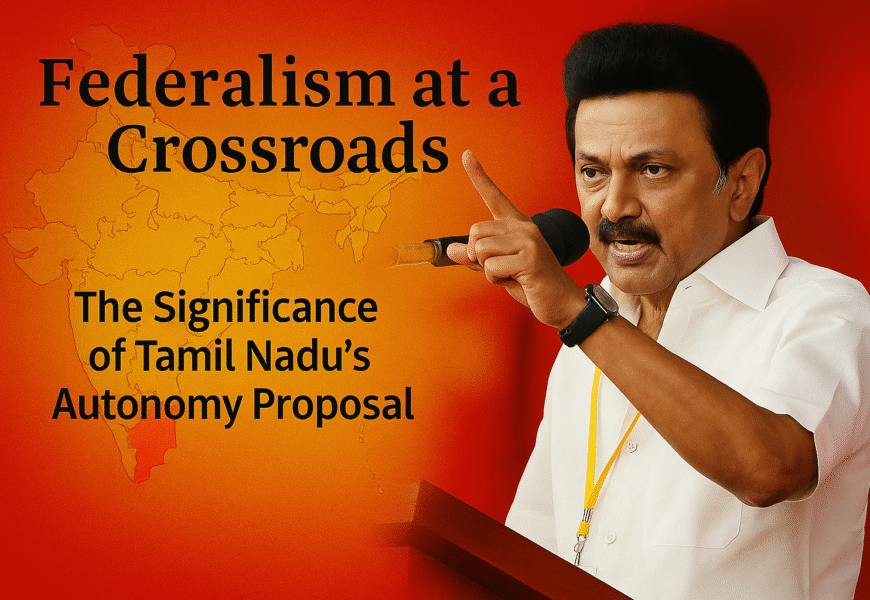
However, the reality today tells a different story. Over decades, there has been a systematic erosion of the powers of the States, and Tamil Nadu’s case stands as a striking example of the challenges faced. Against this backdrop, the autonomy proposal initiated by Tamil Nadu’s Chief Minister M.K. Stalin has reignited the national conversation about federalism, justice, and equity in the Indian Union.
Historical Context: Federalism and Its Erosion
The Indian Constitution in its original form provided a healthy distribution of power between the Centre and States, balancing unity and diversity. Yet, successive Union governments have gradually centralized authority, often encroaching on the domain of the States by expanding the Concurrent List, overriding State laws, and using financial controls to curb State autonomy.
Tamil Nadu, a historically vibrant and economically significant State, has particularly felt the brunt of this centralization:
Economic and Fiscal Erosion: Tamil Nadu, despite being India’s second-largest economy and a manufacturing powerhouse, receives only ₹0.29 for every rupee it contributes to the Union. The implementation of the Goods and Services Tax (GST) has stripped States of their fiscal sovereignty, leading to significant revenue losses for industrial hubs like Tamil Nadu.
Territorial Loss: The 1976 handover of the historically Tamil island, Katchatheevu, to Sri Lanka without the consent of the Tamil Nadu people remains a deep wound. This decision, taken unilaterally by the Union government, has had lasting implications on Tamil fishermen’s livelihoods and India’s territorial integrity.
Educational Discrimination: Central initiatives like the National Eligibility-cum-Entrance Test (NEET) have undermined Tamil Nadu’s progressive education policies. NEET disproportionately impacts students from rural, marginalized, and economically weaker backgrounds, violating the State’s social justice framework.
Language and Cultural Threats: The new National Education Policy’s perceived Hindi-imposition threatens to erode Tamil Nadu’s linguistic identity. Adding insult to injury, the Union withheld approximately ₹2,500 crore meant for Tamil Nadu’s education programs, penalizing the State for resisting Hindi-centric policies.
Political Representation: Tamil Nadu’s success in population control — achieved through proactive awareness campaigns — ironically risks costing it dearly. The upcoming 2026 delimitation could reduce Tamil Nadu’s representation in Parliament, punishing its responsible governance while rewarding States that failed to curb population growth.
Strategic and Global Relevance of Tamil Nadu
Beyond domestic politics, Tamil Nadu holds strategic importance on the global stage:
Economic Gateway: With over 1,000 kilometers of coastline along the Indian Ocean, Tamil Nadu is a critical node in global supply chains. The State is a magnet for multinational investments, hosting pledges of hundreds of billions of dollars from companies like Microsoft, Hyundai, Apple,First Solar and Sembcorp.
Geopolitical Importance: Tamil Nadu’s geographical proximity to Southeast Asia enhances India’s Act East Policy. The Vladivostok-Chennai Maritime Corridor (VCMC) is set to become a vital route for energy and commodity transport from Russia, enhancing Tamil Nadu’s stature in the Indo-Pacific strategy.
Any destabilization of Tamil Nadu’s governance structure could thus have ripple effects not just across India but across the global economy.
The Autonomy Proposal: A Timely Necessity
Recognizing these multi-dimensional challenges, Chief Minister M.K. Stalin’s call for greater State autonomy is not just a political move; it is a historical necessity. His proposal demands a recalibration of Centre-State relations to:
- Restore the States’ rights over subjects like education, health, and agriculture.
- Ensure fiscal fairness by revisiting the GST framework and direct tax sharing.
- Protect linguistic and cultural identities by resisting homogenization.
- Safeguard political representation based on principles of equity and justice.
Tamil Nadu’s autonomy movement could garner global attention, much like how the Gilgit-Baltistan autonomy proposal attracted international backing due to its relevance to China’s CPEC projects. The world increasingly recognizes the importance of regional autonomy in maintaining stability in crucial economic corridors.
Power shared, Nation united
The Tamil Nadu autonomy proposal is not about secession; it is about reasserting the federal principles that are the foundation of India’s unity. At a time when global stability is deeply interlinked with regional dynamism, respecting Tamil Nadu’s aspirations is vital for India’s own economic future and democratic health.
As India moves into its 76th year of independence, the question is not whether States like Tamil Nadu deserve autonomy — the real question is whether India can afford to ignore it.