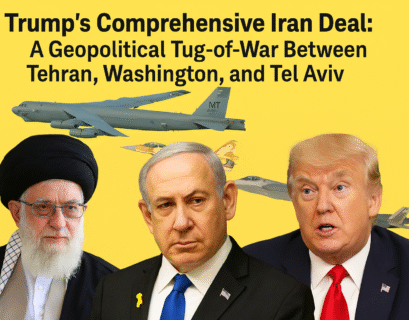
The United States’ recent airstrike—code-named Operation Midnight Hammer—on Iranian nuclear facilities at Fordow and Natanz, executed by B-2 stealth bombers, marks a significant flashpoint in the evolving Middle East crisis. The operation, followed swiftly by Iran’s retaliatory strikes on U.S. military installations in Qatar and sustained aerial attacks on Israeli cities like Haifa and Tel Aviv, has created an intense moment of geopolitical suspense. But the question remains—is this the beginning of a wider war, or is it a carefully choreographed exit strategy?
Historical Echoes: The Shadow of Iraq and the Israel Lobby
The backdrop of this escalation bears striking resemblance to the events preceding the 2003 Iraq invasion. Then, as now, claims about weapons of mass destruction, pressure from Israeli leadership, and the influence of pro-Israel lobbies in Washington played key roles.
Israeli Prime Minister Benjamin Netanyahu has consistently warned of Iran’s nuclear ambitions, echoing a rhetoric that once amplified the threat of Saddam Hussein. This narrative, repeated over years, positions Iran as an existential threat—not just to Israel but increasingly to Western cities like New York, as Netanyahu recently suggested.
Figures like John Bolton—a vocal advocate of the Iraq war—have continued to apply pressure on successive U.S. administrations to adopt a hardline stance. However, the current U.S. landscape under Donald Trump’s renewed political rise is vastly different, shaped by war fatigue, internal economic stress, and a political movement (MAGA) that champions non-interventionism.
A Different Iran: Stronger, Smarter, Resilient
Unlike Iraq in 2003, Iran is not a weakened or isolated state. It has developed formidable aerial capabilities, evidenced by its direct strikes on Israeli cities that challenged the efficacy of the Iron Dome and forced thousands to flee to Cyprus and Greece. The myth of Israeli invincibility has been publicly dented.
In addition, Iran’s nuclear program has made considerable advancements, and even if partially damaged, the country has shown resilience in continuing its scientific progress. Videos from Iranian media suggest that the U.S. bunker busters only struck near facility entrances, not their hardened cores—casting doubt on the effectiveness of the strike.
The Iranian response, striking U.S. bases in Qatar, showed both restraint and precision. While no major U.S. personnel casualties have been reported—likely due to pre-emptive asset relocation—the attacks sent a clear message: Iran can and will retaliate.
A Pattern of Managed Escalation
What is unfolding now isn’t entirely new. A strikingly similar pattern emerged in January 2020, following the U.S. assassination of Iranian Quds Force commander Qasem Soleimani. In response, Iran launched missile strikes on the Ayn al-Asad airbase in Iraq—one of the largest U.S. installations in the region.
While the missile barrage was dramatic and caused significant structural damage, there were no American fatalities, a result largely attributed to advanced warnings and evacuation. Many analysts concluded that Tehran deliberately avoided U.S. casualties to prevent a full-blown war—signaling strength without crossing the red lines that would invite catastrophic retaliation.
This episode now looks like a precedent for “managed escalation”: a framework where each side engages in symbolic or limited strikes that allow for domestic posturing and deterrence—without unleashing uncontrollable conflict. The same logic appears to be at work today.
Symbolic Warfare and Strategic Messaging
There is growing speculation that Operation Midnight Hammer was more performative than existential. Trump’s subsequent push for a new deal with Iran, combined with statements like Senator JD Vance’s (“we don’t fight with Iran, we fight with its nuclear program”), signals an attempt to maintain leverage without entrenching in a broader conflict.
Both Washington and Tehran appear to have engaged in a choreographed cycle of strike and counterstrike—designed to appease domestic constituencies, demonstrate strength, and then return to the negotiating table with improved standing.
Importantly, Iran has not yet activated its proxies (like Hezbollah in Lebanon or militias in Iraq), and no maritime blockades have been initiated—two escalation vectors that would signal full-scale regional war.
The Diplomatic Dilemma in Washington
Trump’s administration, while militarily assertive, is torn between competing internal forces. On one hand, pro-Israel hawks demand a show of strength and regime containment. On the other, MAGA conservatives and libertarians urge a focus on domestic priorities and a retreat from costly foreign entanglements.
This internal tug-of-war creates a policy paralysis, where military operations serve more as spectacle for political optics than as components of a long-term strategy. Trump’s hesitation to follow up the strike with full-scale conflict—despite intense lobbying—demonstrates this constraint.
International Panic and the Call for Ceasefire
The operation and its aftermath have rattled the international community. Fearing a wider regional war that could spike oil prices, destabilize shipping lanes, and disrupt global markets, multiple world powers are pushing for an immediate ceasefire. European capitals, along with Gulf neighbors, are urging de-escalation through backchannel diplomacy.
Interestingly, both Iran and the U.S. have left enough space for off-ramps. The damage is contained, the rhetoric is fierce but not irreconcilable, and the global consensus leans toward restraint.
A Calculated Escalation or a Staged Exit?
In the theater of Middle Eastern geopolitics, Operation Midnight Hammer may well serve as a symbolic climax rather than the opening act of a regional war. The restrained retaliation from Iran, the limited destruction, and the political messaging from both sides all point to a strategic choreography rather than uncontrolled escalation.
This moment reflects a balance of fear and ambition—where each actor seeks to claim victory without plunging into irreversible chaos. Whether this fragile equilibrium holds will depend not just on Washington or Tehran, but on the ability of global actors to rein in extremities, mediate diplomacy, and navigate between symbolism and strategy