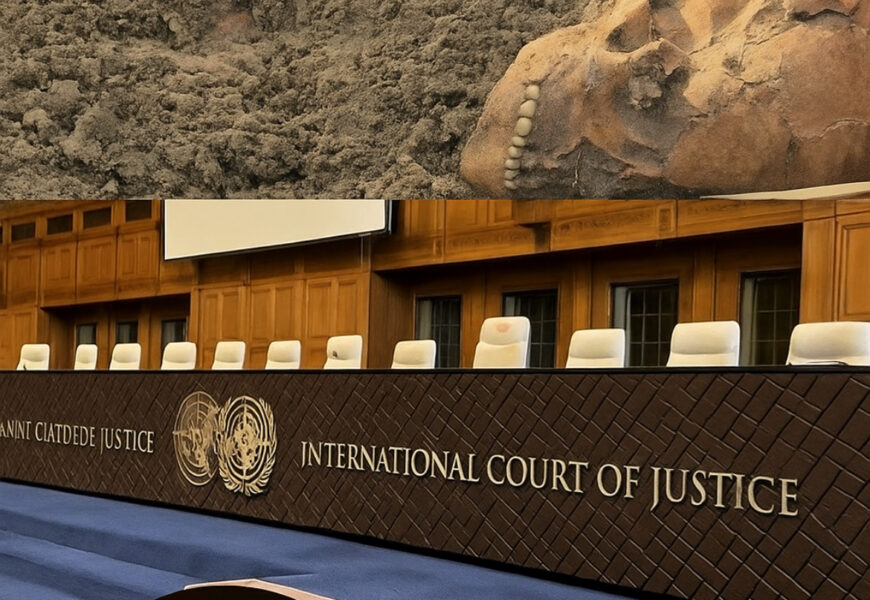
The recent excavation of mass graves in Chemmani has once again brought the Sri Lankan Tamil crisis to the forefront of the international stage. The atrocities committed during Sri Lanka’s decades-long ethnic conflict, culminating in the Mullivaikkal massacre of 2009, have remained largely unpunished despite a wealth of evidence and decades of advocacy. For over 15 years, discussions on justice for Eelam Tamils have been largely confined to the United Nations Human Rights Council (UNHRC), which, while significant for advocacy, lacks the prosecutorial powers to deliver accountability. Neither the UN Security Council (UNSC) nor the UN General Assembly (UNGA) has substantively debated or acted on the Tamil genocide issue, leaving survivors with symbolic resolutions but no path to justice.
As the 60th Session of the UNHRC approaches in September 2025, Tamil communities worldwide are reigniting conversations on how to internationalize the issue. The discovery of new mass graves offers an opportunity to reinvestigate accountability pathways and push for meaningful legal and political action. However, competing proposals—from pursuing universal jurisdiction cases to seeking the International Court of Justice (ICJ) or even a new international tribunal—require strategic evaluation.
This article examines the limitations of existing mechanisms like OSLAP, explores the feasibility of adopting a Syrian-style IIIM model, and outlines how jus cogens norms and universal jurisdiction can work together in a multi-pronged strategy for justice and political recognition.
Limitations of OSLAP: A Mandate Too Weak to Deliver Justice
In 2021, the UNHRC created the Office of the Sri Lanka Accountability Project (OSLAP), designed to collect and preserve evidence of war crimes and human rights abuses. However, OSLAP suffers from structural weaknesses:
- Minimal Resources: A staff of only 11 and a modest budget of $2 million hinder its operational capacity.
- Short Mandate: Extended only until September 2025, with uncertainty over future renewal.
- Hostile State Cooperation: Sri Lanka’s refusal to engage with OSLAP and its domestic repression limit evidence gathering.
- Legal Restrictions: OSLAP’s evidence is primarily for advocacy, not direct prosecution.
- NGO Concerns: Organizations like Human Rights Watch and Amnesty International have flagged these shortcomings, warning that OSLAP cannot meet the scale of justice required.
For a case as grave as genocide, where intent must be proven beyond reasonable doubt, OSLAP’s limitations highlight the urgent need for a stronger, prosecutorially oriented investigative mechanism.
Learning from Syria: IIIM as the Gold Standard
The International, Impartial, and Independent Mechanism (IIIM), created for Syria in 2016, provides a powerful precedent. Unlike OSLAP, IIIM’s mandate is explicitly prosecutorial:
- It collects, consolidates, and analyzes evidence to prepare case files for national, regional, and international courts.
- It operates independently from political constraints, allowing its evidence to feed into ICC, ICJ, or hybrid tribunal proceedings.
- IIIM’s investigative rigor has set a global standard for building airtight legal cases in complex conflicts.
For the Tamil genocide case, a similar IIIM for Sri Lanka would be the most effective starting point to ensure comprehensive documentation, establish command responsibility, and prepare legal arguments that meet international evidentiary standards.
Mechanism-by-Mechanism Analysis
1. International Criminal Court (ICC)
- Challenge: Sri Lanka is not a signatory to the Rome Statute, meaning the ICC has no automatic jurisdiction.
- Pathway: The UNSC could refer Sri Lanka to the ICC, but geopolitical realities—particularly certain veto powers—make this scenario unlikely.
- Assessment: Politically unfeasible at present, despite strong evidence.
2. International Court of Justice (ICJ)
- Feasibility: The ICJ adjudicates disputes between states, not individuals. Under the Genocide Convention (1948), any state party could file a case against Sri Lanka for breaching its obligations.
- Requirement: A sympathetic state sponsor willing to bring a case, supported by IIIM-quality evidence.
- Value: A case at the ICJ would carry immense political weight, formally recognizing Tamil suffering on the global stage and pressuring Sri Lanka diplomatically.
3. Universal Jurisdiction (UJ)
- Scope: Allows national courts anywhere to prosecute individuals for crimes like genocide, regardless of where they were committed.
- Strengths:
- Offers a realistic avenue to prosecute Sri Lankan military and political leaders.
- Creates international legal precedents and generates political pressure.
- Limitations:
- Cannot grant self-determination or sovereignty rights.
- Focuses on individual criminal accountability rather than systemic political solutions.
Nonetheless, universal jurisdiction is a viable grassroots strategy, particularly when coordinated across multiple jurisdictions.
4. Jus Cogens Norms: The Legal Foundation
Jus cogens (peremptory norms of international law) prohibits genocide, torture, and crimes against humanity. These norms are binding on all states and override claims of sovereignty or immunity. Establishing Sri Lanka’s actions as violations of jus cogens:
- Invalidates state immunity defenses for perpetrators.
- Provides the legal basis for universal jurisdiction prosecutions.
- Frames the Tamil genocide as a fundamental breach of international law, demanding a global response.
Toward a Multi-Pronged Strategy
Given geopolitical challenges, a hierarchical and strategic approach is necessary:
- Evidence First:
- Establish an IIIM-style body for Sri Lanka to compile prosecutable evidence of genocide, focusing on intent and command responsibility.
- Address OSLAP’s limitations by advocating for a mandate upgrade at the UNGA.
- Legal Recognition:
- Pursue an ICJ case via a friendly state under the Genocide Convention. Even if enforcement is slow, it carries monumental symbolic legitimacy and places Sri Lanka’s crimes under legal scrutiny.
- Grassroots Justice:
- File universal jurisdiction cases in Tamil friendly states to hold perpetrators criminally accountable and create sustained political pressure.
- Narrative Power:
- Continuously frame Sri Lanka’s genocide as jus cogens violations to strengthen diplomatic efforts and shift international discourse from “human rights concerns” to international crimes demanding justice.
- Long-Term Vision:
- While ICC or a special international tribunal may be politically out of reach now, building an irrefutable evidence base and international legal momentum sets the stage for future prosecutions and Tamil self-determination discussions.
Conclusion
The Chemmani excavations are not just a tragic reminder of Sri Lanka’s violent history—they are a renewed call for global accountability. Tamil advocacy must evolve beyond symbolic UNHRC resolutions to a multi-tiered justice strategy, leveraging IIIM’s investigative rigor, ICJ, jus cogens legal frameworks, and universal jurisdiction to achieve tangible progress.
True justice for Eelam Tamils will require persistence, legal sophistication, and political courage. The time to lay the groundwork for that future is now.