The ascension of the People’s Republic of China as a global economic power can be regarded as the most significant development in the global political circumstances of this millennium. Together with some Southeast Asian countries, China, Japan, and South Korea contribute to the production of a significant proportion of globally traded goods. Along with the growth of these economies, their energy requirements also increased, resulting in the elevation of the geostrategic importance of the Indian Ocean Region to an unprecedented level.
Indian Ocean region’s strategic importance stems from the sea lanes that originate from the Hormuz Strait and Mozambique channel. Traversing a route which progresses via some ports in the littoral states and islands scattered across the ocean, the ships transiting through these lanes reach the Strait of Malacca which then leads to the South China Sea, enabling the delivery of Middle East oil to East Asian economies. Hence, the security of these sea lanes is integrated with the stability of Indian Ocean islands and its littoral countries.
MILITARIZATION AND INSTABILITY
Interestingly, some island countries in Indian ocean region have been experiencing frequent instabilities in recent years. Indo-China rivalry is often quoted as the cause for these destabilizing events. Most political observers in India and west alike are of the opinion that China is encircling India with multiple military bases.
It was Indian strategic thinkers who initially came up with a theory, which is now called “String of pearls”, for the alleged construction of Chinese military bases in Indian ocean. Evidently, over the period of time, this theory had proved to be nothing more than just a misinformation campaign carried out by the intelligence community of India, to get the consensus of its citizens for military expansions into the Indian ocean region.
The most geo strategically located islands in Indian ocean are Sri Lanka, Andaman and Nicobar, Maldives, Mauritius, Seychelles, and Madagascar. And it is not a coincidence that India has installations of military importance in almost all of these island countries. These installations and bases are justified by Indian establishment as a requisite for thwarting Chinese threat and the safety of sea lanes. But on the contrary, it became the persuasion for Chinese to enter Indian ocean region for safeguarding their energy import routes.
To begin with, the surge in Indian ocean’s insecure strategic environment, which was not initiated by China, is the result of India’s imperial ambitions. The Indian maritime doctrine continuously had persuaded Chinese and other east Asian countries, who rely on these transit routes for their energy requirements, to recast their military objectives in protecting their stakes in this ocean.
“The search for energy security pushes these countries in turn to neutralize any nation’s military superiority in Indian ocean, thereby, pulling them into a vicious path of further militarization of this region”
SEEDS OF ESCALATION
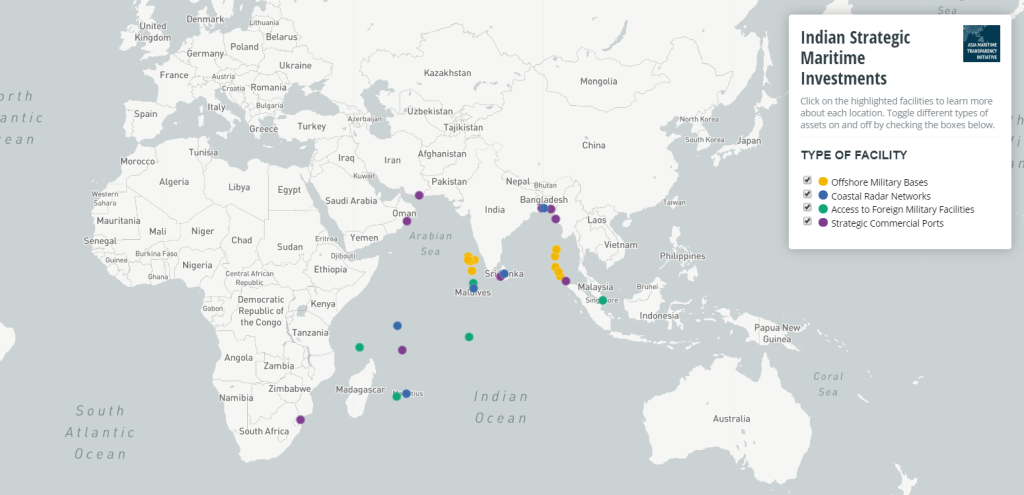
The establishment of a Tri-Service command of India at Andaman Nicobar Island in 2001 was a result of the convergence of Indian union’s foreign policy with that of United states’ Asia pacific (currently renamed as Indo-Pacific) policy. China construed this alliance between the United States and Indian Union as a potential threat to its sovereignty as the Andaman command gave an unprecedented manoeuvring capabilities for Indian navy with respect to the transportation through Malacca strait en-route to china. This prompted China to respond by gaining a foothold in Gwadar city of Pakistan, to construct a transportation passage connecting its Xinjiang province with Arabian sea, and Kyaukpyu town of Myanmar to connect its Yunnan province with Bay of Bengal.
The maritime strategy of India as outlined by its navy in 2007 under the title “Freedom to Use the Seas: India’s Maritime Military Strategy” clearly boasts the ambitions of India in establishing a variety of military installations along the contours of this vast ocean. Over the next decade, it has achieved its stated aims by acquiring bases and listening posts in regions overseeing entry and exit points of Indian ocean. With the increased economic size, China started to wield its power through investment initiatives which brought countries under its zone of influence. Although the Chinese built ports are located in strategic locations, considering the reality, the ports in Sri Lanka, Pakistan, and Myanmar do not carry military significance for China as yet.
“Ironically, Chinese, who took investment initiatives to exert their influence, got squarely blamed for militarization of Indian ocean region by the western countries who chose to overlook the bases established by Indian navy”
TAMIL FACTOR
Tamils, one of the longest surviving ethnic groups in the world, live predominantly in Indian Union, Sri Lanka, Malaysia, Singapore, Mauritius, Maldives, with a significant diaspora population in many western countries. Tamils were the most significant driving force for the trades that happened across south and south eastern Asian region until the last century. China’s ambitious project of Belt and Road Initiative, which aims at the proliferation trade routes, has a close resemblance in the historic Spice Route trade carried out by Tamils.
“Tamils once championed a capitalism that catered for prosperity without exploitation, as a result of which Tamil homeland and China witnessed a peaceful coexistence”
With the advent of British India and the emergence of Non-Tamil power centres, the trading ideology got fundamentally altered and a coercive exploitation came into existence, as a result of which the foreign policy of Indian union started perceiving participation of Tamils in political decision making as a threat to their measures of exploitation.
As Tamils have their homeland situated at the heart of this ocean, they are vulnerable to various forms of cultural and ethnic assimilation measures that aim to destroy their unique identity and sovereignty.
British Empire, which begot the Indian Union, along with other power centres in Delhi and Mumbai made extensive measures during the 19th and 20th century in the proliferation of racist theories that spread hatred against Tamils, among other ethnic groups of this region. Some of the classic examples for these measures includes
- The translation of a Buddhist epic Mahavamsa, which carries a strong aversion towards Tamils, from an extinct Pali language to English and Sinhala languages that resulted in the ongoing ethnic conflict in the island of Sri Lanka.
- The imposition of Dravidian identity on Tamils with an objective of destroying the Tamil Identity.
- The Nationalization of private Banks that were founded by Tamil entrepreneurs by the union government of India.
- The pogrom against Burma Tamils which resulted in nationalization of wealth held by Tamils by then government of Burma.
Successive governments in Delhi implemented policy measures to tilt the demographic balance against Tamils in most of these island countries and deprive them of their political rights. Today, Tamils in these countries have no say in foreign and domestic policies. This enabled the government of India to thrust its futile foreign policy on these small nations which exposed them to the ongoing power battle between India and China.
ANDAMAN ISLANDS- A CASE FOR DE-ESCALATION
Tamils constitute a significant proportion of demographics in Andaman and Nicobar Islands. This chain of islands possesses a capacity to host a huge military infrastructure which could possibly escalate the confrontation between Indian and Chinese sides to new highs. Currently it is kept under the direct jurisdiction of Delhi, as a union territory. This enables Indian bureaucracy to implement preposterous policies, threatening the peace of India, without any scrutiny of an elected Legislative assembly representing the aspirations of its people. Hence, Andaman and Nicobar Islands should be brought under the control of Tamil Nadu government with which it enjoys a historic connection since time immemorial. Historically, Andaman was a part of Tamil homeland. In the years after the 1940s, there were concerted efforts in increasing the non-Tamil population on the island by sponsoring a migration from north and north eastern states of Indian union. As a result of this, presently, migrated Bengalis account for the majority of its population pushing the native Tamils to a minority position.
As the neighbouring countries like Malaysia and Singapore having a significant Tamil and Han Chinese population who are living peacefully, the annexure of Andaman Islands with Tamil Nadu and thereby bringing these strategic islands under the purview of a democratically elected government of Tamil Nadu state will secure the de-escalation of the Indo-Chinese tension in Malay Peninsula.