In the evolving landscape of global power competition, the United States faces a strategic inflection point: how to translate its enduring military might and technological leadership into industrial advantage, secure supply chains, and a reasserted Western Hemisphere hegemony. Recent developments — from ambitious Arctic posturing toward Greenland to symbolic interventions in Venezuela and diplomatic initiatives in Gaza — reveal a deeper strategic logic beneath the surface.
The Arctic Icebox Becomes the Center of Gravity
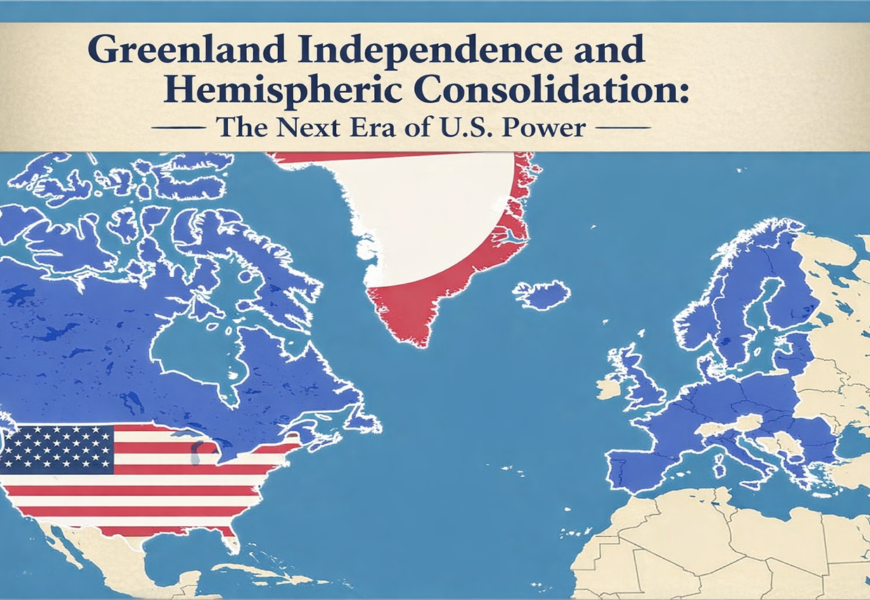
For decades, Greenland was dismissed by policymakers and pundits as an icy wasteland of little consequence. Today it sits at the heart of U.S. strategic thinking. Under President Donald Trump’s second administration, Greenland has re-emerged as a geopolitical prize — not merely for its location but for its long-term industrial value.
The island’s importance is multi-layered:
- Strategic location: Greenland lies at the entrance to the Arctic, a region that is opening to shipping and resource access as polar ice recedes. Its military and radar installations — especially the U.S. Pituffik base — are critical to continental defense.
- Critical minerals: Greenland is believed to hold significant deposits of rare earth elements, crucial for electric vehicles, renewable energy, advanced electronics, and defense technologies. Securing access to these resources would lessen U.S. dependence on Asia-centric supply chains dominated by China.
- Great-power competition: The Arctic has become a theater in which Russia and China are expanding influence; U.S. interest in Greenland can be seen as part of a hemispheric defense approach.
Greenland’s strategic pull illustrates a broader shift: the U.S. is thinking in terms of industrial advantage and resource security, rather than traditional territorial conquest.
Greenland Independence as Strategic Design
Washington’s interest in Greenland is not structured around annexation, but around engineered sovereignty.
A potential long-term framework would see:
- Greenland moving toward formal independence from Denmark,
- Continued integration into NATO’s security architecture,
- Retention and expansion of U.S. military bases,
- Preferential American access to rare-earth and Arctic resources,
- And political–economic coordination effectively shaped from Washington.
In this arrangement, Greenland becomes a buffer state, logistics hub, and mineral platform for the United States and NATO — not a colony, but a managed strategic partner that anchors the northern edge of the Western Hemisphere.
A Modern Monroe Doctrine for Industrial Reassertion
This strategic focus has echoes of an updated Monroe Doctrine — not in the old 19th-century sense of opposing European colonialism in the Americas, but as a framework for control of the Western Hemisphere’s critical infrastructure and economic lifelines. Greenland in the north and Latin America in the south become pivot points for U.S. leadership:
- Greenland’s Arctic value lies in minerals, surveillance, and supply routes.
- Latin America — whether in trade, energy, or political alignment — remains central to hemispheric dynamics.
The implicit logic is that industrial competitiveness and strategic autonomy begin close to home, not in protracted conflicts on the other side of the globe.
EU Aligns — But Not Without Reservations
European Union leaders are caught in a delicate balancing act. On the one hand, they share concerns with the United States about Russia and China gaining leverage in the Arctic. On the other, aggressive U.S. pressure over Greenland has raised fears of sovereignty erosion and Atlantic disunity.
The EU’s push for strategic autonomy — repeated at the World Economic Forum in Davos — reflects deeper anxieties about dependence on U.S. security guarantees. Yet in practice, Europe lacks the demographic depth, industrial capacity, technological scale, and military reach to counter Arctic competition alone. Alignment with Washington is therefore a strategic compulsion, not a choice.
The Message in the Middle East and Latin America
At the same forum in Davos, the Trump administration unveiled a “Board of Peace” initiative to rebuild Gaza, framing U.S. engagement in humanitarian and reconstruction terms rather than traditional military escalation. This signals a preference for diplomacy over direct war.
Meanwhile, high-impact actions such as the arrest of Venezuelan President Nicolás Maduro — framed as law-enforcement and anti-narcotics measures — serve as messages of continuing global reach. These actions reassure allies, deter rivals, and remind the world that U.S. power remains operational, even when long-term occupation is not the goal.
This creates a two-level policy:
- Visibility-driven signaling outside the hemisphere,
- Structural, long-term consolidation inside it.
Industrial Revival, De-Globalization, and Supply Chains
The contemporary U.S. strategic challenge is no longer simply military dominance — it is industrial competitiveness in a de-globalizing economy. Supply-chain shocks have exposed vulnerabilities in semiconductors, batteries, rare earths, and advanced manufacturing.
From this standpoint:
- Arctic minerals are more valuable than Middle Eastern oil.
- Regional supply chains reduce foreign leverage.
- The Western Hemisphere becomes a self-sustaining industrial sphere.
A Strategic Pivot Hidden in Plain Sight
When viewed together, U.S. policy reveals a pivot toward industrial power, hemispheric consolidation, and resource security. The emphasis on Greenland and the Arctic, combined with symbolic global signaling, sends a clear message:
America is still a superpower — but its future will be decided not in distant wars, but in factories, minerals, data corridors, and polar trade routes.
The next era of global power will be built not on battlefields — but on supply chains.