
“A belief system is inevitable in any society irrespective of its position in the civilizational ladder. These beliefs transform accordingly with the developments in the society and matures with the passage of time into a more rigorous form that is perceived as their culture and tradition which is unique to every society. A religion is an implementation of this belief system through the process of institutionalization”
A fact that this subcontinent never had a unified culture at any point in time is required to debunk the sophistries in the name of Hinduism. It is a no-brainer to understand that Hinduism is not defined as a single religion by the Constitution of Indian Union, as it says “people who don’t belong to Islam, Christianity, and Sikhism are Hindus”. Often this is used as an argument to justify a fairy-tale history which proposes: despite having multiple cultures throughout history, the people living in this subcontinent had a unifying philosophy which is rooted on the Vedas and it prevailed across these different cultures, thus uniting them under a single Religion called Hinduism.
The demand for the resuscitation of orthodox Tamil liturgical principles for the consecration of Peruvudaiyar temple is a quintessential pronouncement by Tamils that they are not Hindus. This demand exposes the fact that Tamils are unhappy with being branded as Hindus. This may be perplexing for an outsider who construe Tamils as Hindus. This prejudicial opinion is the result of a well-orchestrated disinformation efforts for the past one hundred years, premeditated by British and followed by the subsequent rulers in Delhi with a motive to subsume various “culturally diversified and autonomous” entities of this subcontinent under a non-existing religion called as Hinduism.
WHAT IS HINDUISM?
The subcontinent gave rise to many independent philosophies at different times in history, some of which are surviving today as they were institutionalized in the form of multiple independent religions. As it is evident from the historical sources, many of these religions are completely independent of one another. Hence, the terminology of Hinduism should be understood as referring to a group of independent religions begot by the different cultures of this subcontinent. Thus, the “meaning of the term Hinduism is Geographical and Collective” and should not be perceived as referring to any single religion. The most prominent religions that are referred by this collective terminology are:
- Saivam
- Vainavam
- Buddhism
- Jainism
- Brahmanism
A close analogy for the development of such independent religions from a particular geographical region can be found in “Abrahamism”. Abrahamism is a terminology used for referring to the independent religions which developed and flourished from the same geographical region on the Mediterranean basin. The most prominent Abrahamic religions are:
- Judaism
- Christianity
- Islam
There is no difficulty in comprehending the independent nature of Judaism, Christianity and Islam because of the establishment of the word ‘Abrahamism’ (Abrahamic religions) as a collective terminology. On the other hand, the independent nature of Saivam, Buddhism, Jainism, and Brahmanism have not been properly articulated, since the last century, giving raise to the misconception that Hinduism is a single religion.
“The idols of worship belonging to the northern part of this subcontinent, like Saibaba, Buddha, Mahaveer, Rama, etc., are as alien to Tamils as the deities of Abrahamic religions”
A PRECEDENCE BY LINGAYATS
Lingayatism is a religion that was founded on the ideologies of a twelfth century Philosopher called Basava. This religion emerged from the principles of “Veerasaivam”, a religion of Kannada people whose principles are their adaptation of Saivam religion. In the recent years, the lingayats have demanded for a separate religious status for Ligayatism as it is considered by the constitution of India as part of Hinduism. Their demand forced the state government of Karnataka to send a request to the union government for according a separate religious status. This request was rejected by the union government fearing the demanded status would expose the dubiousness of their definition of the term “Hinduism”.
ANCIENT TAMIL CULTURE
Every ancient ethnic group had developed their belief system as a framework for the sustenance of their society in the highly volatile situations prevalent in ancient times. As Tamils possessed a great propensity for maritime trade, they had to rely on the astronomical information during the voyages across the vast ocean adjacent to their peninsular homeland. Thus, the dependence of Tamil society and its economy on the maritime trade ushered in the intellectual pursuit for understanding the nature of the night sky. Thus, the wisdom attained through such devoted efforts contributed to the development of philosophical principles that resulted in the development of deities personifying various cosmic phenomena that were understood by ancient Tamils. Tholkappiyam, which is the oldest surviving text of this subcontinent, identifies four Tamil gods: Murugan, Indiran, Varunan, and Maayon.
Until approximately two thousand six hundred years ago, the entire subcontinent was the homeland of Tamils with the exception of some inhabitable forest regions which were incapable of supporting an urban civilization. The then landscape of this subcontinent was filled with urbanized Tamil empires in most regions with non-Tamil clans occupying the adjacent lands of those empires. Subsequent centuries witnessed an emergence of different philosophical school of thoughts other than Tamil traditional schools in the Gangetic Plains along the north-western parts of this subcontinent with Jainism, Brahmanism, and Buddhism being the prominent among them.
Despite having some differences between them Jainism, Buddhism, and Brahmanism converged to destroy Tamil philosophies and traditions. This is evident from the fact that Sangam Tamil civilization was not defeated in Battle fields, but destroyed by the cultural sabotage carried out by these three schools of thought. Of these, Buddhism and Jainism played a crucial role in the destruction of Tamil tradition by demolishing the Sangam era culture. This destruction of Tamil Culture and tradition allowed the intrusion of Brahmanism into Tamil homeland in the later years.
THE RISE OF SAIVAM AND VAINAVAM
With the fall of Sangam era due to the cultural conquests by foreign religions, Tamil culture saw the evolution of their gods into a different form consistent with the changed reality. Thus, prominent gods like Sivan and Thirumaal emerged from their previous Sangam era forms. As these transformations were happening, the cruelties of Buddhism and Jainism were going beyond the tolerable extents and Tamils felt the need to eradicate these non-Tamil religions. This was the advent of Bakthi Movement during the fifth century common era which initiated the cultural battle of the Tamil religions of Saivam, Vainavam against Buddhism, Jainism, and Brahmanism. It took almost five centuries for these revolutionary Tamil traditions to wipe out the treacherous Buddhism and Jainism from Tamil Homeland completely. But Brahmanism took two different forms such as “Smarta tradition” and “Srauta tradition”. It is surviving till this day in these two forms. While the Smarta tradition follows Vedangas and Idigasas, the Srauta Tradition follows Vedas and Upanishads. The Smarta tradition was founded by a Brahmin called Adi Shankara and it denounces the gods of Saivam and Vainavam.
EXCLUSIVITY OF MURUGAN WORSHIP TO TAMILS
Albeit giving rise to various philosophical traditions of worship such as Aasivakam, Saivam, Vainavam, Indiram, Tamils had never given their allegiance to a culture that emanated from outside their homeland until the fall of great Chera, Chola and Pandya dynasties in the mediaeval period, which enabled the Christianity and Islam to gain some roots in this land.
Devotion for lord Murugan, who predates almost every deity, is the longest surviving tradition among Tamils because of its resilience and hence it preserves the essence of Tamil culture since ancient times. Thus, Murugan worship is an adoration unique to Tamils which is evident from the exclusivity of Murugan Temples only to Tamil inhabited regions.
GEOPOLITICAL OUTREACH OF SAIVAM
Tamil society’s disposition for maritime trading had enabled it to establish a vast maritime transit network connecting various regions across Kumari kadal (present day terminology -Indian ocean). With the flourishing of trade, mercantile Tamil communities established their trading hubs in the littoral countries of this ocean. Often these habitations included a Saivite Temple, many of which are surviving till this day, exemplifying the outreach of Tamil traders and Saivam along the contours of this vast ocean. Though trade was ongoing between the coasts of Tamilagan and other littoral regions of Indian ocean during the rule of colonial Non-Tamil kingdoms such as Pallavas and Chalukyas, the thrust for a friendly relationship between Tamils and Han Chinese increased during the time of medieval Tamil cholas. This empowered Tamil Saivam to transcend economic and geographical barriers with the auspices of the great chola emperors.
With the ascension of the great Rajendra Cholan as the chola emperor, Tamils’ empire building endeavour had reached unprecedented levels since the Sangam era. His brilliance in military skills accompanied by his devotion for Tamil god Sivan resulted in the establishment of an empire that resonated with Tamil ethos. Trading relations enabled cultural transmission from Tamilakam to far east Asian countries. The chola empire was regarded in high esteem by the contemporary kingdoms in Asian region, which encouraged the adoption of Tamil traditions into their culture.
Rajendran wielded his influence across the south eastern kingdoms, by bringing them under his suzerainty. Rajendra Cholan’s fondness for a peaceful coexistence with Chinese empire was evident from his successful dismantling of the Buddhist Sri Vijaya Empire in the strategic Malay peninsula as they were rankling the trade between two great empires, viz. Tamil Empire and Chinese empire. This military conquest again explicates the complete independency of Saivam with respect to Buddhism and Brahmanism.
SMARTA RELIGION’S WAR AGAINST TAMIL SAIVAM
There are multiple events in modern history during which the mask of Hinduism had fallen and the faces of Smarta Brahmins and Marwari Jains beneath it have been exposed. The most obvious being their collusion with the Buddhist governments of Burma and Sri Lanka during the Genocidal onslaughts against Tamils during 1962, 1983 and 2009 respectively.
BURMESE BUDDHISTS GENOCIDE OF TAMIL SAIVITES
During the colonial era, Tamils played a vital role in the development of Burma converting waste swathes of barren lands into arable lands. This contributed enormously to the economic growth of Burma during and after the colonial era. But ignoring such contributions of Tamils in the development of their country, the Burmese military rule established during 1962 usurped the wealth of Tamils, vandalized their properties and forcefully driven them out of the country. The inaction of Indian union government during these attacks against Tamils by a Buddhist government depicts the animosity of Smarta Tradition against Tamil Saivam.
SINHALA BUDDHISTS GENOCIDE OF TAMIL SAIVITES
Eelam Tamils, majority of whom are Saivites, faced destruction of their aspirations for freedom from Sinhala Buddhist country through a genocide by relentless military conquests for more than four decades and colonial occupation since 2009, which were possible only with the help of Indian Union government. The hostilities against Eelam Tamils remain immutable since 1940s, because of India’s futile foreign policy. India has supported the genocide of Tamils during the phase of Armed struggle and helped the perpetrators of genocide to remain in power in Sri Lanka after the end of the war. The foreign policy of India has always remained hostile towards Saivam. This stems from the fact that, cultural soft power exerted by the rulers in Delhi, on south and south East Asian countries have their roots in the Chola empire which is regarded as a Golden era of Tamil culture and Saivam. While Cholas played a pivotal role in the spread of Saivam across Indian ocean littoral region and the Smarta Brahmins and Marwaris are trying to exploit it by subjugating Saivam under their Hinduism.
ONGOING BATTLE BETWEEN SAIVAM AND SMARTA RELIGION
Ever since Britain united Tamil homeland and the rest of this subcontinent without a referendum, Saivam is seen as a threat by the Hindutva project conceived and nurtured by Smarta Brahmins and Marwaris. Hence, they are involved in multiple attempts to dissolve the Saivite culture through various strategies that includes implantation of Corporate backed pseudo-Spiritual personalities such as Ravishankar and Jaggi Vasudev in Tamil Nadu for articulating Anti Saivite opinions to demean Saivam and vitiate Tamil society. Consequently, Saivite institutions and preachers are being constantly persecuted by these people. The transition of India’s depiction, as a ‘Secular country’ to a ‘Hindu majoritarian country’, in the opinion of International community in recent years since the ascension of BJP to the union government of India, has increased the requirement to firmly establish the fact that Saivam and Vainavam are separate religions of Tamils and they are absolutely opposite to the vicious religion of Hinduism which is propagated by Smarta Brahmins and Marwaris.
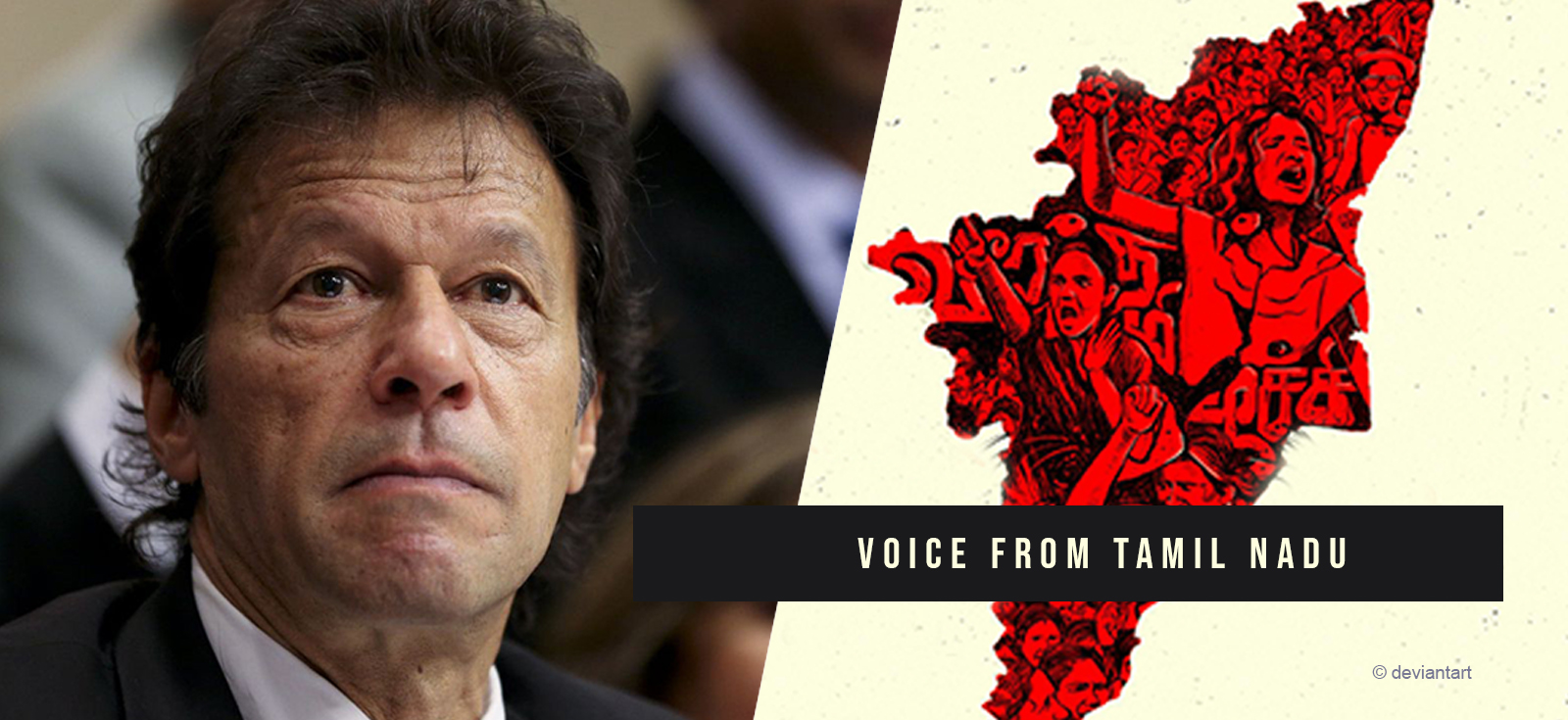
Imran Khan’s branding of the National freedom struggle of Tamils led by LTTE against Buddhist Sinhala government of Sri Lanka as an Armed struggle of Hindus, during his speeches at Pakistan’s parliament immediately after the Pulwama incident and later at United Nations General assembly, exposes the concerted efforts by the Islamic Republic of Pakistan and the Indian Union in imposing the Hindu Identity upon Tamils at multilateral level. Despite the erudite nature of his explication about the emergence of Suicide as a strategy in multiple socio-political struggles, his reference to Tamils as Hindus demands denunciation and many politically informed Tamils had condemned his expedient use of their freedom struggle in the United Nations.
The fact that Hinduism and Tamil religions are not related is vindicated by the “exclusion” of Eelam Tamils in the recent Citizenship Amendment Act (CAA) passed by the union government of India, which declares Hindu immigrants in India to be eligible for its citizenship.
Hindus from other states of this country, who find vanity in the majoritarian projects undertaken by Delhi governments, should understand a truth “the government which pretends to worry about the declining Hindu population is the same government that is constantly tilting the demographics of every ethnic group in their own states to their disadvantage, by sponsoring interstate migration that originates from Hindi belt”. Religious and caste hostilities that gets instigated frequently are just a pretence that conceals the ulterior motives of the rulers in Delhi.
THE REASON BEHIND SMARTA RELIGION’S ASSAULTS AGAINST SAIVAM
The motive for such insidious attacks against the Tamil Saivites masterminded by the policy framers, who are mostly adherents of Smarta religion or Jainism, is that only Saivam religion has the potential to expose the delusion created by the Smarta religion about the term Hinduism. This single religion idea is propagated by the Smarta Brahmins and Marwari Jains in order to maintain their political clout over the entire subcontinent, which is only possible as long as the people believe this idea of Hinduism that puts Smarta religion at supreme position over other religions under the pretence of Hinduism.
These attacks are the result of the fact that Saivam has historically proven the actuality -Buddhism, Jainism, and Smarta Brahmanism are independent religions and they can never be considered as a part of another religion which is an amalgamation of all these religions (propagated as “Hinduism”). Hence, the word “Hindu” has no meaning. Only the words like Saivite, Vainavite, Buddhist, Jain, Lingayats, Sikhs, and Smarta brahmin have real meanings, indicating the followers of those religions respectively.
THE REFLECTION OF HATRED AGAINST TAMILS ON INDIAN UNION’S FOREIGN POLICY
The foreign policy of Indian Union has been ruined since its independence as it is being framed by the people with such anti-Tamil (i.e. Anti-Saivam) thought process. While some foreign policies neither benefited Indian Union nor the intended countries, most policies have been Zero-Sum in nature, which undermined the integrity of the subcontinent. This is evident from the hostile approach by the thoughtless policy framers towards China’s emergence as a regional power in Asia. Recently a Hindu Majoritarian attitude is evident in the foreign policy and it is instigating a trade war with countries like Malaysia and Turkey. The failure of Indian Union to secure a buffer state in the Island of Sri Lanka, by destroying the Tamil Independence movement, has severely undermined its Security with the increased Multilateral involvement in the region. These are some obvious expounds concerning the futile nature of Indian Union’s foreign policy.
Despite having a policy precedence given by cholas, India is failing to implement a Foreign policy that would benefit its citizens and create a cordial environment with respect to the south and south east Asian countries.
A sensible foreign policy for Indian Union with regards to the Indian ocean region is one which is coherent with the chola outlook (a Tamil perspective) for the Indian ocean region which doesn’t make the regional countries to choose either the Indian union side or Chinese side. Unfortunately, the incompetence of the present policy framers is making it impossible for any viable policy to materialize this goal.


