
India Decolonized Politically, But Not Administratively: Does India Still Need the UPSC-IAS-IFS-IPS Bureaucratic Empire?
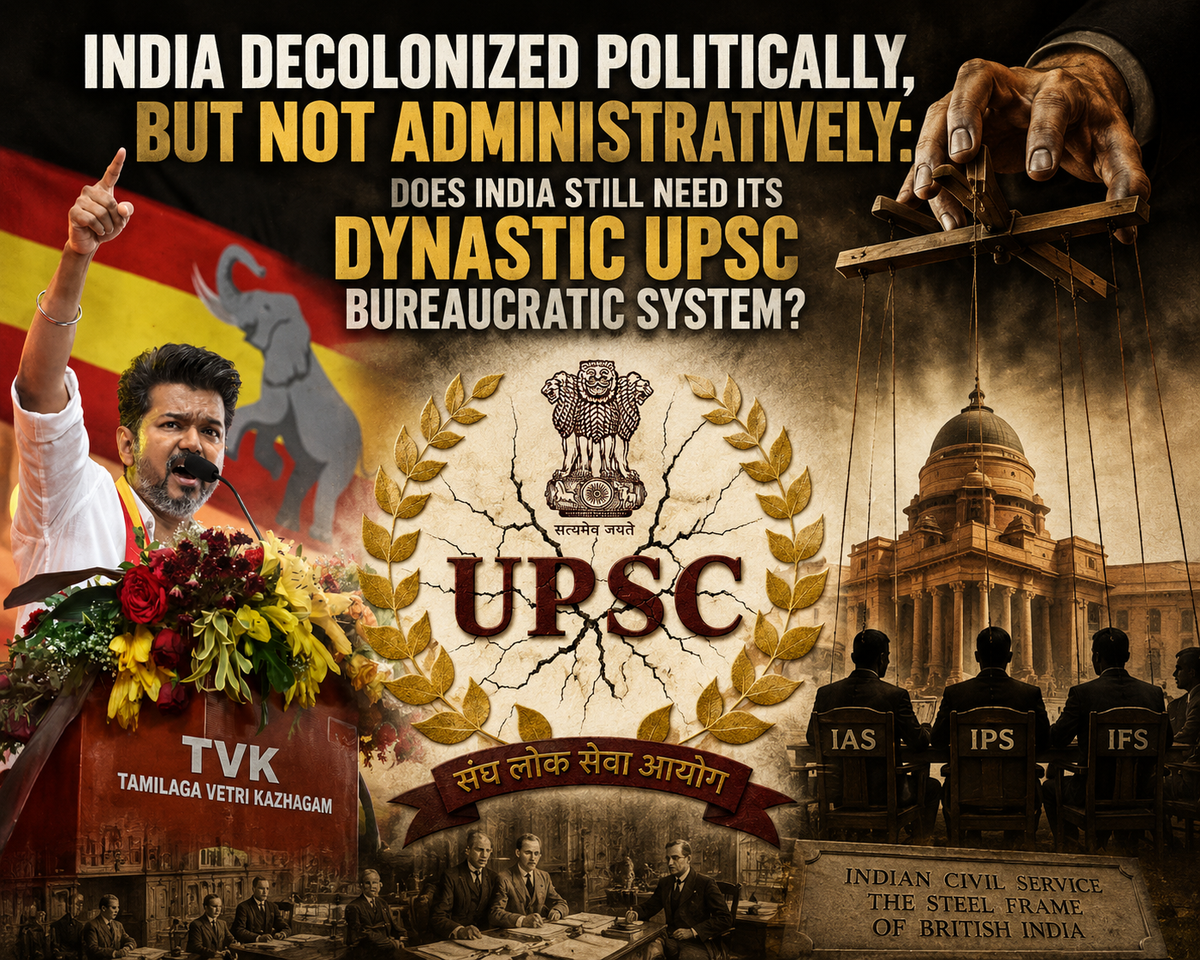
For the first time in nearly six decades of Tamil Nadu politics, actor-turned-politician Vijay and his party Tamilaga Vettri Kazhagam (TVK) have emerged as a potential alternative to the long-standing bipolar dominance of the Dravidian parties. Like previous chief ministers, Vijay is expected to rely heavily on the state’s administrative machinery, including senior IAS and IPS officials, to shape governance and policy implementation. However, this raises a deeper political question: if Tamil nationalism and Dravidian ideology form the core principles of TVK’s politics, can a centralized civil-service structure — historically shaped by Delhi-centric administrative traditions — truly implement Tamil Nadu-centric policies? Or will the permanent bureaucratic establishment ultimately shape, moderate, or constrain the agenda of any elected government, regardless of ideology?
India celebrates itself as the world’s largest democracy. Elections are massive, governments change frequently, and political debates are loud and visible. Yet beneath this democratic structure exists another layer of power that changes very little: the centralized permanent bureaucracy inherited from colonial rule.
The modern Indian state continues to rely heavily on institutions created not for democratic participation, but for imperial administration. The structure of the Indian Administrative Service (IAS), Indian Police Service (IPS), governors, district collectors, and even parts of the foreign diplomatic establishment (IFS) emerged from systems designed by the British Empire to control territory, extract revenue, and maintain political order.
Independent India replaced colonial rulers, but much of the colonial administrative machinery survived almost intact.
This continuity raises an uncomfortable question: “Has India fully democratized its political system, or has electoral democracy merely been layered on top of a centralized bureaucratic state?”
From Colonial Rule to Administrative Continuity
The roots of India’s bureaucracy lie in the Indian Civil Service (ICS), often called the “steel frame” of the British Empire in India.
The ICS was never intended to empower citizens. Its purpose was:
• maintaining imperial authority,
• collecting taxes,
• suppressing unrest,
• administering provinces from the center.
District collectors, police administrators, and governors functioned as instruments of centralized colonial control.
After independence in 1947, India retained much of this structure. The ICS evolved into the IAS, the Imperial Police became the IPS, and centralized administrative authority remained deeply embedded in governance.
Leaders such as Sardar Vallabhbhai Patel defended this continuity, arguing that a newly independent and diverse nation required administrative stability to prevent fragmentation.
That concern was understandable in the aftermath of Partition.
However, structures designed for colonial administration do not automatically become democratic simply because the flag changes.
Over time, the bureaucracy transformed from a temporary stabilizing mechanism into one of the most powerful unelected institutions in the republic.
The Rise of the Permanent Administrative State
Elected governments in India come and go. Bureaucratic institutions remain.
Ministers often depend heavily on senior civil servants for:
• drafting policy,
• interpreting regulations,
• controlling files,
• implementing programs,
• managing budgets,
• coordinating with the judiciary and central agencies.
This creates a system in which unelected administrators can significantly shape governance even when public mandates change.
In theory, bureaucrats merely implement decisions made by elected leaders. In practice, policy execution often determines the real outcome of governance.
An elected government may promise decentralization, welfare reform, educational change, Foreign or industrial policy, but implementation passes through permanent administrative layers that possess institutional continuity, procedural expertise, and long-standing networks of influence.
This creates what many scholars describe as a “permanent state” operating beneath electoral politics.
In several controversial policy areas, critics argue that centralized bureaucratic structures have overridden or diluted the positions of elected state governments and regional political mandates. Debates surrounding GST, NEET, language policy, river-water disputes, centrally appointed governors, and national entrance examinations, the policies of Tamil ethnic crisis in neighbor state Srilanka all reflect tensions between electoral federalism and administrative centralization.
For many regional political movements, especially in southern India, the concern is not simply policy disagreement but the belief that unelected bureaucratic institutions increasingly shape national priorities while reducing the effective power of state-level democratic mandates.
Centralization and the Weakening of Federal Democracy
India’s constitutional structure describes the country as a union of states. Yet many major policy areas have become increasingly centralized over time.
The expansion of centralized taxation under the Goods and Services Tax Council (GST Council), national educational testing frameworks, centrally designed welfare systems, and bureaucratic oversight mechanisms has steadily reduced state-level autonomy.
Critics argue that this trend weakens federal democracy.
The debate around National Eligibility cum Entrance Test (NEET) reflects this tension clearly.
Supporters argue that centralized examinations create uniform standards and reduce corruption in admissions. Critics argue that such systems disproportionately favor:
• urban students,
• English-medium education,
• coaching industries,
• socially advantaged groups.
Many states believe centralized examinations undermine regional educational systems and reduce democratic control over local policy priorities.
Tamil Nadu, in particular, has witnessed sustained political opposition to NEET across multiple elected governments, political parties, and social organizations. Critics argue that despite repeated electoral opposition and legislative resistance within the state, centralized bureaucratic and judicial structures continued imposing a uniform national framework over regional educational models.
The issue is larger than NEET itself. It represents a broader shift toward technocratic centralization where policy decisions increasingly emerge from national bureaucratic frameworks rather than local democratic processes.
Similarly, debates around GST revealed tensions between elected state governments and centralized fiscal policymaking. Critics argue that states increasingly depend on centrally negotiated revenue structures while losing taxation flexibility that once reflected regional economic priorities.
Several state governments have argued that fiscal centralization under GST reduced their independent policy flexibility while increasing dependence on decisions negotiated through central institutions heavily influenced by bureaucratic and technocratic frameworks.
For critics of centralization, these developments collectively represent a gradual transfer of power away from state electorates toward national administrative systems.
Elite Continuity and Bureaucratic Networks
One of the least discussed aspects of India’s civil services is the social continuity within elite administrative circles.
Officially, recruitment occurs through merit-based competitive examinations conducted by the Union Public Service Commission (UPSC). Many talented candidates from ordinary backgrounds enter the services every year.
Yet social capital still matters enormously.
Access to:
• elite schooling,
• English fluency,
• metropolitan networks,
• policy circles,
• coaching institutions,
• diplomatic exposure,
• family familiarity with the system
creates invisible advantages that are difficult to quantify but impossible to ignore.
This phenomenon is particularly visible in diplomacy, strategic affairs, economic policymaking, and elite administration.
For example, S. Jaishankar, former Foreign Secretary and later External Affairs Minister, comes from one of India’s most influential strategic-policy families. His father, K. Subrahmanyam, was among India’s most powerful defence and strategic policy thinkers. His brother, Sanjay Subrahmanyam, became a globally respected historian, while another brother, S. Vijay Kumar, served in senior administrative roles including Rural Development Secretary. The family is frequently cited as an example of India’s elite policy-service networks.
Similarly, Shivshankar Menon emerged from a diplomatic family deeply connected to government service. His father served in the Indian Foreign Service, and his grandfather had associations with administration during British India. Such continuity reflects how bureaucratic culture and statecraft knowledge often remain concentrated within established administrative circles.
Another example is Kanwal Sibal, who came from an influential legal and administrative family network connected to senior public institutions. His career reflected a broader tradition in which elite administrative and diplomatic circles often reproduce themselves socially across generations.
Perhaps the clearest example is the lineage of K. P. S. Menon and K. P. S. Menon Jr. — father and son who both became among India’s top diplomats. Their careers symbolized how diplomatic traditions could continue within families across generations.
The same pattern extends into economic and cabinet administration. T. V. Somanathan emerged from a family associated with strong academic and administrative traditions before rising to become Finance Secretary and later Cabinet Secretary. Montek Singh Ahluwalia also came from circles deeply connected to public administration and state policy institutions.
Within defence and strategic bureaucracy, K. Subrahmanyam played an extraordinary role in shaping India’s national security thinking, while his son later became both Foreign Secretary and External Affairs Minister — creating one of the most influential policy-service lineages in modern India.
Similarly, G. Mohan Kumar emerged from a prominent Kerala public-service background connected to administrative and public institutions.
Even newer generations continue these trends. Kanishak Kataria, who topped the UPSC examination, came from a family where both his father and uncle were IAS officers. Devyani Khobragade is the daughter of a senior IAS officer and emerged from a family with longstanding bureaucratic connections. Pooja Khedkar also came from a politically and bureaucratically connected background.
None of these examples alone prove corruption or wrongdoing. Many individuals from such families are highly qualified and capable.
However, collectively they raise important democratic questions.
In India, especially among older elite bureaucratic circles, the transition from ICS to IAS/IFS often continued through social and familial continuity. Children of diplomats, IAS, IPS, defence officials, and senior administrators historically enjoyed advantages such as:
• elite education,
• policy exposure from childhood,
• Delhi and Lutyens networks,
• familiarity with UPSC culture,
• mentorship from established officials,
• social confidence within state institutions.
Over time, this contributed to the emergence of what many observers describe as “bureaucratic dynasties,” particularly within:
• Delhi policy circles,
• Tamil Brahmin administrative families,
• Kashmiri Pandit diplomatic networks,
• Kerala public-service families,
• Punjabi civil-service circles.
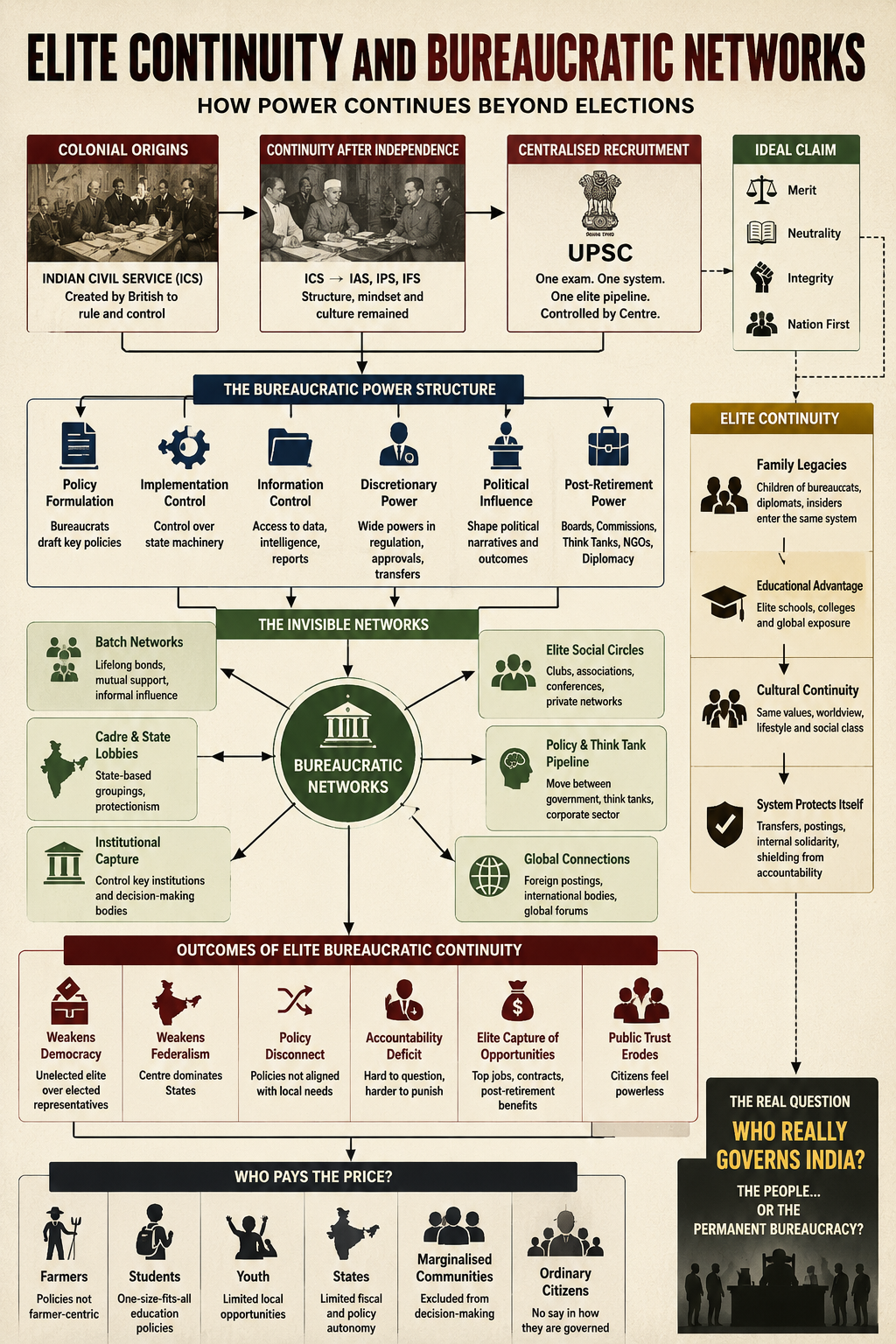
The concern is not ethnicity or community itself. The larger issue is concentration of administrative influence within narrow social ecosystems that may unintentionally limit broader representation and diversity of institutional thinking.
Democracy requires more than open examinations. It also requires broad social participation in policymaking itself.
Foreign Policy, Sri Lanka, and Democratic Distance
India’s foreign policy establishment has historically remained insulated from public debate.
Major strategic decisions regarding:
• Sri Lanka,
• China,
• the United States,
• regional security,
• trade,
• refugee crises
have often been shaped within relatively closed administrative and diplomatic circles.
The final phase of the Sri Lankan Civil War remains deeply controversial, particularly in Tamil political discourse and among human-rights activists who describe the mass civilian killings during the war’s end as a genocide against Sri Lankan Tamils.
One of the strongest criticisms made by Tamil political groups is that India’s strategic and bureaucratic establishment supported or enabled Sri Lankan state actions despite widespread opposition from elected Tamil representatives in Tamil Nadu.
Critics argue that:
• concerns raised by Tamil political parties,
• protests across Tamil Nadu,
• demands from regional elected representatives,
• and humanitarian warnings from civil society
were ultimately subordinated to centralized strategic calculations made within New Delhi’s foreign-policy and security establishment.
For many critics, this became an example of how centralized bureaucratic and strategic institutions could bypass regional democratic sentiment on issues deeply affecting a linguistic and ethnic community with historical ties across borders.
Many critics argue that the perspectives of Tamil civilians and regional political concerns were insufficiently represented within New Delhi’s strategic establishment. Instead, geopolitical calculations dominated policymaking.
Whether one agrees or disagrees with India’s actions during that period, the episode highlighted a deeper structural issue:
foreign policy in India is often highly centralized and insulated from democratic scrutiny.
The concern is not that individual diplomats alone determine national policy. Elected leaders make final decisions. However, when expertise, information flow, and institutional memory are concentrated within small bureaucratic networks, those networks inevitably shape the range of choices presented to political leadership.
For critics of India’s Sri Lanka policy, the issue was not only foreign policy itself, but the broader democratic question:
How much influence should unelected strategic and bureaucratic institutions possess when elected regional voices strongly disagree?
Bureaucracy and Political Corruption
Ironically, centralized bureaucracy was originally justified as protection against political corruption. In reality, the relationship between politicians and bureaucracy often evolved into mutual dependency.
Politicians require:
• administrative compliance,
• regulatory flexibility,
• file movement,
• bureaucratic protection.
Bureaucrats require:
• favorable postings,
• career advancement,
• political backing,
• institutional protection.
This symbiotic relationship can weaken accountability on both sides.
Frequent transfer politics, selective enforcement, regulatory discretion, and administrative opacity create conditions where corruption becomes systemic rather than individual.
The result is not merely political corruption or bureaucratic corruption separately, but a hybrid structure in which administrative power and political power reinforce one another.
The Technocratic Argument — and Its Limits
Defenders of centralized bureaucracy argue that India’s size and complexity require a strong administrative core.
There is truth in this argument.
A country of India’s scale cannot function without:
• permanent institutions,
• policy continuity,
• coordinated administration,
• disaster management systems,
• legal and financial expertise.
However, administrative necessity should not become a justification for democratic insulation.
Technocracy without accountability risks creating a system where:
• experts dominate citizens,
• procedures dominate representation,
• central institutions dominate local realities.
The purpose of democracy is not merely efficient governance. It is public participation in governance.
Lessons from Other Countries
Most modern states possess permanent civil services, but the balance between bureaucracy and democracy varies significantly.
The United States uses a more politically controlled administrative system in which many senior officials change with elected governments.
France has long struggled with criticism of technocratic administrative elites dominating public policy.
China operates an extremely centralized bureaucratic state under party control, prioritizing efficiency and state authority over democratic accountability.
Singapore is often praised for administrative efficiency but is also criticized for centralized technocratic governance.
India occupies a unique position:
a highly centralized bureaucratic structure functioning within a noisy electoral democracy.
This creates constant tension between democratic politics and administrative continuity.
Toward a More Democratic Administrative System
The solution is not necessarily the destruction of civil services. Every modern state requires administration.
The real challenge is democratizing administration itself.
Possible reforms include:
• greater decentralization to states and local governments,
• stronger municipal and panchayat autonomy,
• domain-specialist recruitment,
• transparent performance evaluation,
• reduced transfer-based political control,
• fixed tenure systems,
• parliamentary scrutiny of bureaucratic decisions,
• increased public consultation in policymaking,
• lateral entry from academic and professional sectors,
• stronger transparency mechanisms.
India does not merely need efficient governance. It needs governance that remains accountable to citizens rather than insulated administrative hierarchies.
Conclusion
Independent India succeeded in removing colonial rulers, but many colonial administrative structures survived with remarkable continuity.
The centralized bureaucracy helped preserve national stability during fragile decades after independence. Yet over time, concentration of administrative authority has also created democratic distortions:
• weakening federalism,
• insulating policymaking,
• reproducing elite networks,
• limiting local participation,
• enabling opaque state power.
Critics increasingly argue that controversies surrounding NEET, GST, governor interventions, fiscal centralization, and India’s role during the final phase of the Sri Lankan Civil War all reveal the same structural issue:
the growing distance between centralized administrative power and regional democratic consent.
The challenge before India is no longer national survival. It is democratic deepening.
A republic cannot remain fully democratic if too much authority rests permanently in institutions beyond meaningful public accountability.
The future of Indian democracy may ultimately depend not only on free elections, but also on whether India can transform its colonial administrative inheritance into a genuinely people-oriented system of governance.
For Tamil Nadu, this debate has become especially important at a time when questions of federalism, linguistic identity, education policy, taxation, and regional autonomy are increasingly shaping political discourse. If parties such as Tamilaga Vettri Kazhagam seek to advance a Tamil Nadu-centric governance model, then the state may also need a broader public discussion on the role and structure of centralized civil services themselves.
Such a discussion cannot remain confined to political parties or bureaucratic institutions alone. It requires participation from:
• civil society movements,
• academicians,
• constitutional scholars,
• retired administrators,
• economists,
• federalism experts,
• Tamil think tanks,
• policy researchers,
• student organizations,
• and similar democratic and regional-policy groups from other Indian states facing comparable concerns about centralization.
The larger question is no longer merely administrative efficiency. It is whether India can build a model of governance where democratic consent, regional aspirations, and administrative structures exist in genuine balance rather than permanent tension.
Comments ()