Summary
Following the assassination of Iran’s military leader Qassem Soleimani, speculation has spread across global media and social networks. However, most commentary has remained superficial—focusing on simplistic narratives such as:
- Washington’s greed for Iranian oil
- Trump’s distraction from impeachment
- Alleged Iranian violations of the nuclear deal
- Shia-Sunni sectarian conflicts
This article seeks to uncover deeper, often overlooked geopolitical realities behind the US-Iran tensions—specifically from a Tamil nationalist viewpoint.
The Trump–Pence–Pompeo Triad
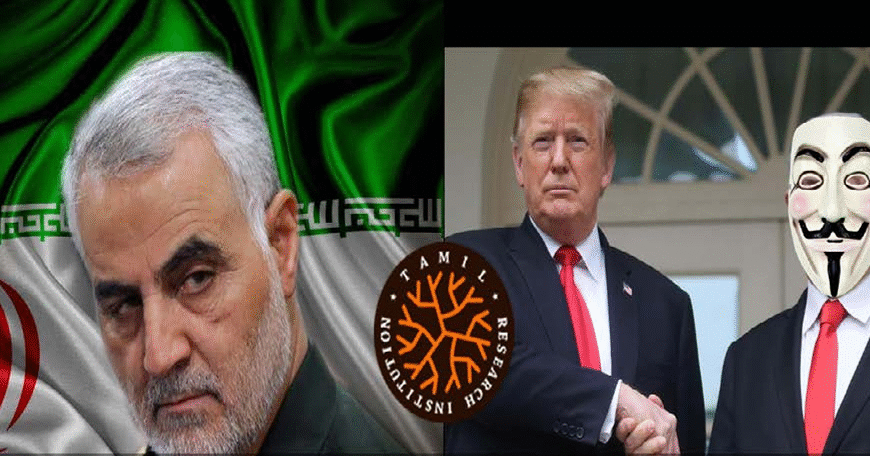
In the wake of Soleimani’s killing, President Donald Trump swiftly claimed responsibility. Vice President Mike Pence stated, “Americans are safer after Soleimani’s death,” while Secretary of State Mike Pompeo asserted Trump’s right to take decisive action against Iran. Despite global condemnation and domestic backlash from US lawmakers, the Trump-Pence-Pompeo trio defended the strike.
What drove this administration to commit such an act? To understand this, one must examine the ideological, political, and religious undercurrents uniting these three figures.
Pompeo’s Islamophobia and Anti-Iran Stance
Soleimani had long been on Washington’s radar. After Trump’s 2016 victory, he appointed the evangelical Mike Pence as Vice President and Mike Pompeo, a known Islamophobe, as CIA Director (and later Secretary of State).
Pompeo’s hostility toward Islam and Iran can be traced back to his congressional tenure (2011–2017). As part of the “Benghazi Committee,” Pompeo amplified suspicions of Iranian involvement in the 2012 embassy attack. Following the 2013 Boston Marathon bombing, his anti-Muslim remarks drew bipartisan criticism. These ideological leanings influenced his hardline policies from within Trump’s cabinet.
The Evangelical Engine Behind US Foreign Policy
The rise of Christian Zionism in the US—especially through Christians United for Israel (CUFI)—has had a significant influence on American policy in the Middle East. Founded by Pastor John Hagee in 2006, CUFI has grown to represent over 50 million evangelical Christians. Its mission: ensure unwavering US support for Israel, promote the expansion of Jewish territory in the Middle East, and marginalize Muslim nations.
CUFI’s power was evident during the 2008 election, where Hagee endorsed Republican John McCain. Although McCain distanced himself later, CUFI’s influence only grew. Mike Pence, then a congressman, actively participated in CUFI summits and developed a close relationship with Hagee.
After Trump’s 2016 win, CUFI’s evangelical vision materialized:
- Electing a pro-Israel, evangelical president
- Appointing anti-Iran hardliners to key positions
- Withdrawing from the US-Iran nuclear deal
- Recognizing Jerusalem as Israel’s capital
These developments were not coincidental but carefully orchestrated steps aligned with CUFI’s long-term goals.
The Path to Conflict: CUFI and the 2016 Shift
CUFI’s reach exploded during the 2016 campaign, mobilizing 20 million Americans using social media platforms—especially Facebook—to promote pro-Trump propaganda. These campaigns played a major role in influencing voter sentiment and later, justifying Soleimani’s assassination through over 800 sponsored Facebook ads.
Trump’s appointments of Pence and Pompeo further cemented this ideological alignment. In July 2017, Pence declared at a CUFI summit: “I support Israel because I’m a Christian.” Pompeo, during a 2018 visit to Israel, met Netanyahu to discuss terminating the Iran nuclear deal. By May 2018, Trump officially withdrew from the deal—despite international evidence showing Iran’s compliance.
Economic Sanctions and Strategic Isolation
Post-withdrawal, Trump launched economic sanctions targeting Iran’s oil exports, intending to cripple its economy and provoke regime change. Contrary to US expectations, Iran’s economy displayed resilience—growth hit 6%, and unemployment dropped to 3.4%.
Israel, alarmed by Iran’s progress under President Rouhani and Soleimani’s regional influence, intensified efforts to provoke conflict. In January 2020, Soleimani was killed by a US drone strike—a move widely seen as a culmination of years of strategic buildup.
Territorial Expansion and Religious Symbolism
Simultaneously, Israel achieved several strategic objectives:
- Recognition of Jerusalem as its capital (US embassy relocated in 2018)
- Formal US recognition of Israel’s annexation of the Golan Heights
- Momentum toward legitimizing Israeli control over the West Bank
Pastor Hagee officiated the Jerusalem embassy inauguration, underscoring the religious motivation behind these geopolitical moves. Meanwhile, Soleimani’s support for resistance groups like Hezbollah and Hamas—regardless of Sunni-Shia divides—made him a threat to Israeli ambitions.
India’s Shift: Hindutva, Zionism, and Foreign Policy
Historically supportive of Palestine and Iran, India’s stance shifted sharply after 2014 with the rise of the Hindu nationalist BJP. For the first time, India voted in favor of Israel at the UNHRC in 2019, opposing Palestinian rights organizations.
Groups like Indians for Israel, led by Vijeta Uniyal, promote Hindu-Zionist collaboration, echoing ideological views from RSS, VHP, and BJP. Hashtags like #IndiaWithIsrael trended during the Israel-Palestine conflict—fueled by Hindu right-wing influencers.
Events like the 2019 conference featuring BJP leader Subramanian Swamy and Israeli academics declared Islamism, socialism, and communism as joint threats to Hindu-Zionist ideals. This alliance is rooted in historical parallels, with Hindutva ideologues like Savarkar praising Zionist movements as early as the 1950s.
Strategic Deals: Chabahar Port and US Leverage
Despite developing the Chabahar port in Iran, India remains bound by US-imposed sanctions. A special waiver was granted by Washington—not out of goodwill, but to counterbalance China’s Gwadar port in Pakistan.
This suggests that the US may ultimately use Chabahar as a naval outpost—via India—to contain Chinese influence in the region.
The Future of the Middle East
As China expands through its Belt and Road Initiative across South Asia, Africa, and the Middle East, and Iran strengthens its missile capabilities, Israel faces increasing pressure. In response, it may continue using the US to impose sanctions, spark internal dissent, or even initiate open conflict to suppress Iran’s rise.
A Call to Tamils: Navigating the Crossfire
India’s Hindutva regime is aggressively projecting all of India’s 1.4 billion people as Hindu and supporters of Modi’s ideology. This false homogenization aims to erase the unique identities of India’s ethnic groups—including Tamils.
While aligning with Zionists and Evangelicals against Muslims, the Indian state also collaborates with Sri Lanka’s Bodu Bala Sena—the group responsible for atrocities against Tamil civilians. RSS has even established training centers in Sri Lanka with the support of BBS, threatening Tamil and Muslim communities in the northeast.
With Article 370 revoked in Kashmir and oil imports from Iran curtailed, Tamil interests are increasingly undermined by India’s foreign alignments. Tamils must resist being subsumed under the Hindutva identity. Doing so would compromise their history, heritage, and struggle for autonomy.
Conclusion
The US-Iran conflict is not merely a bilateral dispute—it is deeply embedded in a complex web of ideological, religious, and geopolitical alignments. Evangelical-Zionist interests, bolstered by right-wing Hindutva forces, are reshaping regional dynamics in ways that harm marginalized groups like Tamils.
In this volatile landscape, Tamils must remain vigilant, reject imposed identities, and pursue alliances that protect their distinct cultural and political aspirations.