
From Mullivaikkal to Gaza: How India’s Arms Support for Sri Lanka and Israel Undermines Its Geopolitical Credibility
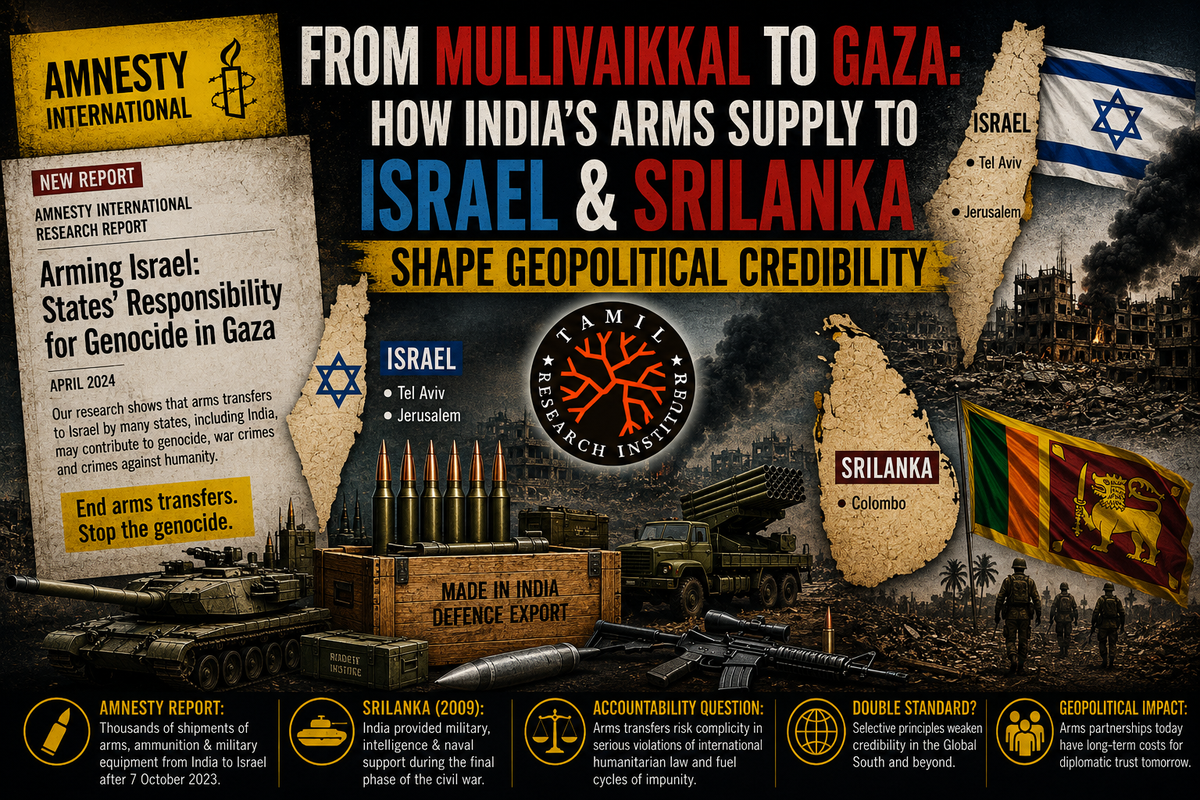
Amnesty International’s recent investigation into military-related exports from India to Israel has reignited an important geopolitical debate. The organization argues that Indian public and private defense manufacturers continued supplying military components, ammunition, and dual-use items to Israel despite mounting allegations of war crimes, crimes against humanity, and genocide in Gaza. Amnesty contends that states should suspend arms transfers where there is a substantial risk that exported items could facilitate serious violations of international humanitarian law.
India has rejected these allegations, maintaining that its exports are governed by a robust legal and regulatory framework and that they comply with domestic law and international export-control obligations.
Regardless of where one stands in this debate, the report raises a broader strategic question that extends beyond the Middle East.
For many observers, particularly among the Tamil diaspora, this is not the first time India’s military partnerships have attracted international scrutiny. During the final phase of Sri Lanka’s civil war in 2009, India provided various forms of military and strategic assistance to the Sri Lankan government. That conflict remains the subject of continuing international accountability efforts concerning alleged mass atrocities committed against Tamil civilians.
Although the conflicts in Sri Lanka and Gaza are fundamentally different in their political, historical, and military contexts, both illustrate a common geopolitical challenge:
How do arms transfers affect a country’s international credibility when those conflicts later become the subject of allegations of war crimes or genocide?
Amnesty’s Findings on India-Israel Defense Exports: According to Amnesty International, investigators identified approximately 2,596 shipments from India to Israel after October 7, 2023.
The report states that these shipments included military-related goods such as: Ammunition and ammunition components, Small arms components, Military vehicle parts, Explosive-related materials, Defense equipment components, Various dual-use industrial products capable of military application
Amnesty argues that these exports continued despite repeated international warnings regarding civilian casualties in Gaza and the legal obligations of states under international humanitarian law.
The organization therefore calls upon governments to suspend transfers where there is a clear risk that exported equipment could contribute to serious violations of international law.
India disputes Amnesty’s conclusions and maintains that its exports comply with its legal obligations and established export-control procedures.
The disagreement therefore is not simply about export statistics.
It reflects two competing interpretations of international responsibility during armed conflict.
Sri Lanka: An Earlier Strategic Controversy
For many Tamils, Amnesty’s latest report inevitably recalls India’s role during the final years of Sri Lanka’s civil war.
During different stages of the conflict, India provided assistance that included: Coastal radar systems, Maritime surveillance cooperation, Naval coordination, Intelligence sharing, Military training, Security cooperation, Diplomatic engagement with Colombo
India consistently stated that these measures were intended to combat terrorism, preserve regional stability, and protect its own national security interests.
Critics, however, argue that this support strengthened the Sri Lankan military during the final offensive in Mullivaikkal in 2009, when United Nations reports documented extensive civilian casualties and allegations of serious violations of international humanitarian law.
Numerous Tamil organizations and human-rights advocates have argued that external military assistance—including assistance from India—should be examined within broader accountability processes.
At the same time, it is important to distinguish between advocacy claims and established legal findings.
No international court has found India legally responsible for genocide in Sri Lanka.
That distinction remains essential for serious geopolitical analysis.
When Arms Exports Become Foreign Policy
Historically, governments often treated arms exports as commercial transactions or strategic partnerships.
Today’s geopolitical environment is different. Military exports increasingly carry diplomatic consequences. Governments are now judged not only by whom they support but also by how those weapons are allegedly used after delivery.
This changing environment has affected multiple countries, including the United States, Germany, the United Kingdom, France, Canada, and others supplying military equipment to active conflict zones.
Amnesty’s report suggests that India is increasingly entering this same international conversation.
Credibility Matters More Than Rhetoric
Countries frequently describe themselves using principles such as: democracy, sovereignty, strategic autonomy, support for the Global South, rules-based international order
Such principles strengthen diplomatic influence only when they are applied consistently.
When military exports become associated with conflicts involving allegations of mass atrocities, questions naturally emerge regarding consistency between diplomatic messaging and strategic partnerships.
This does not automatically establish legal responsibility. However, it can influence international perception.
Diplomatic credibility is shaped not only by official policy but also by how that policy is interpreted abroad.
Comparing India with Major Powers
India is often presented in political discourse as an emerging global force. However, geopolitical influence cannot be measured by rhetoric alone.
The United States continues to exercise unparalleled global influence through military alliances, technological leadership, financial institutions, naval power, and the dominant role of the U.S. dollar.
China’s influence is built upon manufacturing capacity, global infrastructure investment, technological expansion, and deep economic integration across multiple continents.
India occupies a different position. Its influence is significant within South Asia and is expanding through diplomacy, technology, pharmaceuticals, and defense manufacturing. Yet it does not currently possess the comprehensive global economic, military, financial, or technological reach of either the United States or China.
Precisely because India’s international influence relies heavily on diplomatic credibility and strategic partnerships, controversies surrounding military exports may carry disproportionate reputational consequences.
Mullivaikkal and Gaza: Different Conflicts, Similar Questions
The Sri Lankan civil war and the Israel-Gaza conflict should not be treated as identical conflicts.
Each emerged from different political histories, legal circumstances, and security environments.
Nevertheless, both generate similar international questions:
- What responsibilities do arms suppliers carry?
- When should exports be suspended?
- How should governments assess humanitarian risks?
- Should strategic partnerships outweigh humanitarian concerns?
- What standards should apply equally to all states?
These questions increasingly shape modern diplomacy.
The Future of Defense Diplomacy
Defense exports are becoming one of the defining instruments of foreign policy.
As defense industries expand, governments face growing expectations regarding transparency, accountability, and humanitarian due diligence.
International courts, United Nations institutions, human-rights organizations, investigative journalists, and civil society networks increasingly monitor not only battlefield conduct but also the global supply chains supporting modern conflicts.
Whether those findings ultimately produce legal consequences or remain matters of political debate, they influence international reputation.
Conclusion
The significance of Amnesty International’s latest report extends beyond Israel. It illustrates how military exports increasingly affect geopolitical credibility.
The discussion is no longer limited to battlefield conduct alone. It now includes those who manufacture, finance, transport, and authorize military equipment.
For India, the debate recalls unresolved questions surrounding Sri Lanka while simultaneously opening new discussions regarding Gaza.
These controversies do not establish legal guilt by themselves, nor should geopolitical analysis assume conclusions that belong to courts.
However, they demonstrate an important reality of twenty-first-century international politics:
Strategic partnerships may strengthen national security, but they can also reshape international perceptions.
Countries seeking greater diplomatic influence are judged not only by their economic performance or military capabilities, but also by whether their foreign policy appears consistent with the humanitarian principles they publicly endorse.
From Mullivaikkal to Gaza, that question is becomingy increasingly difficult for every arms-exporting nation to ignore.
Comments ()