
Manufacturing Narratives While Burying Reform: How India’s Prime-Time Media Turned a Student Movement into Political Spectacle
A TRI Indian Media Analysis by Arun Kumar R
When students take to the streets demanding educational reforms, a democracy faces an important choice.
It can either engage with the substance of their concerns or become consumed by political narratives that overshadow the issues at hand.
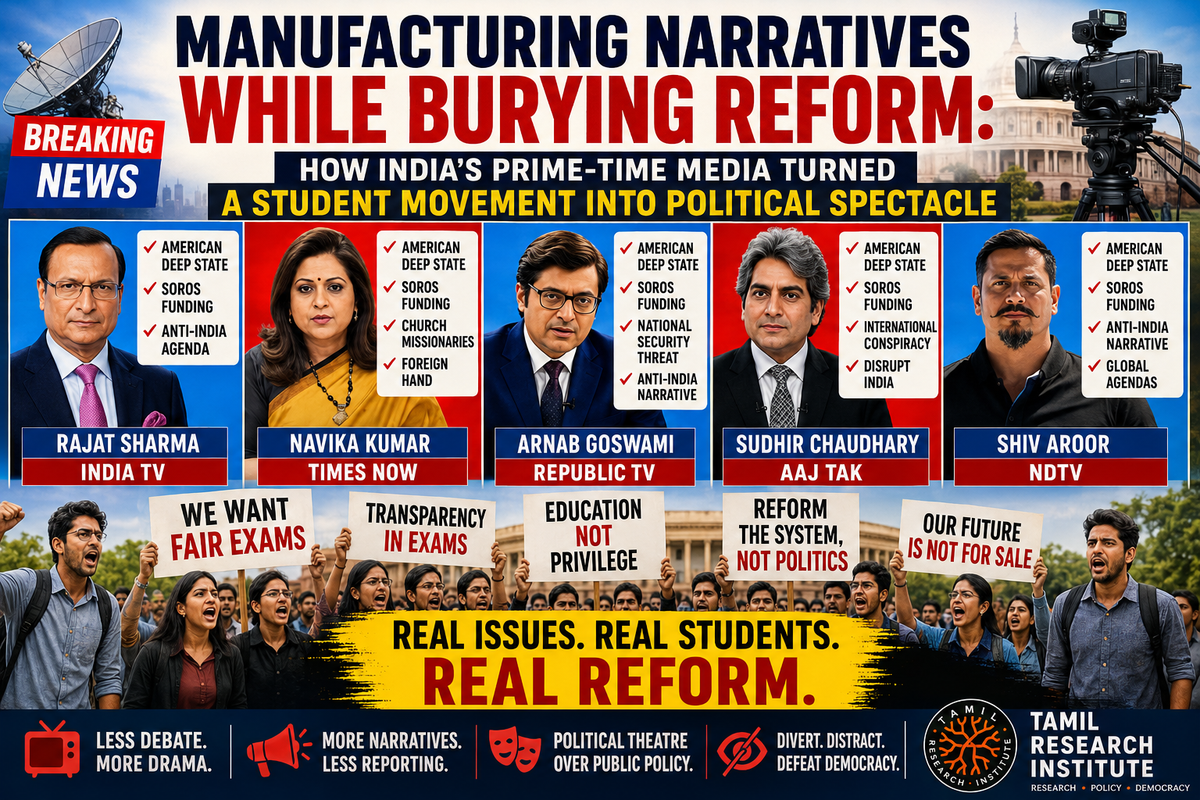
The ongoing Delhi student protests present such a moment. While students have raised concerns about examination integrity, educational governance, institutional accountability, and the growing centralization of educational policymaking, much of India’s prime-time television debate has centered elsewhere.
Instead of asking why India’s examination system repeatedly finds itself under public scrutiny, significant portions of the media ecosystem have focused on political confrontation, allegations of foreign interference, and partisan blame.
The result is a national conversation that often generates more political heat than policy solutions.
The Missing Debate
The questions that deserve sustained national discussion are straightforward.
- Why do recurring controversies continue to affect national entrance examinations?
- Why has public confidence weakened?
- Are existing institutional safeguards adequate?
- Has excessive centralization reduced the ability of States to address local educational challenges?
- Should education policy be rebalanced within India’s federal structure?
These questions affect millions of students.
Yet much of prime-time debate has instead revolved around political accusations and ideological confrontation.
When Every Protest Becomes a Foreign Conspiracy
A recurring pattern within sections of India’s television media is the tendency to quickly attribute domestic protest movements to external actors before fully examining the underlying grievances.
Whether the issue involves education, agriculture, citizenship legislation, or other public policy debates, familiar narratives frequently emerge.
Television discussions often raise allegations involving:
- George Soros
- the “American Deep State”
- foreign-funded NGOs
- church missionary organizations
- opposition political parties “hijacking” protests
If credible evidence exists for any such allegation, it should certainly be investigated through proper journalistic standards and presented transparently.
However, repeatedly elevating speculative geopolitical explanations before examining the substantive policy concerns risks diverting public attention from the actual issues raised by citizens.
The immediate questions surrounding the present student movement concern examination integrity, educational governance, institutional accountability, and constitutional federalism—not geopolitical conspiracy theories.
Political Spectacle Instead of Public Policy
Several prominent television anchors and networks—including personalities associated with Republic TV, Times Now, India TV, Aaj Tak, Zee News, and other major broadcasters—have devoted substantial airtime to questions such as whether opposition parties are benefiting politically from the protests or whether foreign actors are influencing the movement.
Political strategy is a legitimate subject for journalism.
But it should not replace policy analysis.
When political theatre dominates coverage, deeper structural questions receive far less attention.
Millions of students did not leave their classrooms because of international geopolitics.
They protested because they believe India’s education system requires greater accountability.
The Cost of Hyper-Nationalism
Another noticeable trend is the growing use of hyper-nationalist rhetoric to frame public protests.
Policy disagreements are increasingly portrayed as battles between patriots and anti-national forces.
Constructive criticism is frequently interpreted as hostility toward the nation itself.
This creates a dangerous long-term consequence. Patriotism derives its strength from public trust.
If every disagreement, every protest, and every demand for institutional reform is framed as an attack on the nation, genuinely patriotic principles risk becoming politicized and gradually losing their unifying moral force.
National unity is strengthened when citizens are free to question institutions and seek constitutional reforms—not when disagreement itself becomes suspect.
A confident democracy welcomes scrutiny.
It does not fear it.
The Diplomatic Cost of Casual Allegations
Repeatedly attributing domestic political developments to countries such as the United States or vaguely defined “foreign forces” without publicly verifiable evidence may also carry diplomatic consequences.
India’s strategic partnerships are built upon mutual trust and long-term cooperation.
Frequent public allegations that foreign governments are routinely engineering domestic protests can unnecessarily complicate bilateral relationships if they are not supported by evidence.
Responsible journalism requires a clear distinction between:
- verified facts,
- informed analysis,
- political rhetoric,
- and speculation.
Conflating these categories weakens both journalism and public trust.
The Digital Era Has Changed Everything
Perhaps the greatest miscalculation is assuming that narrative control still functions as it did twenty years ago.
Today’s students livestream protests.
Independent journalists publish field reports.
Researchers analyze official documents.
Fact-checking organizations evaluate competing claims in real time.
Millions of citizens consume information from multiple domestic and international sources simultaneously.
Attempts to redirect public attention through sensational narratives are therefore subjected to immediate public scrutiny.
Information now travels in multiple directions.
Television no longer possesses a monopoly over public understanding.
A Pattern Previously Identified by TRI
This is not the first time TRI has examined the relationship between political narratives and information ecosystems.
In its earlier publication,
“India’s Disinformation Architecture: A Threat to Social Harmony and Regional Stability,”
TRI argued that polarized information ecosystems, sensationalism, and politically driven narratives weaken democratic discourse by diverting attention away from genuine public policy challenges.
The current debate surrounding the student protests reflects many of the same concerns.
Rather than facilitating an evidence-based discussion about educational reforms, constitutional federalism, and institutional accountability, significant portions of the national conversation have become dominated by political spectacle.
Journalism’s Democratic Responsibility
Journalism plays a constitutional role within every democracy.
Its responsibility extends beyond broadcasting political conflict.
Its responsibility is to investigate institutions, examine evidence, challenge governments, scrutinize opposition parties, and explain complex policy questions to citizens.
Students deserve discussions about:
- educational reform,
- examination integrity,
- institutional transparency,
- federalism,
- decentralization,
- and constitutional accountability.
These issues will shape India’s future far more profoundly than nightly debates about who gains politically from a protest.
The Assessment
The strength of a democracy is measured not merely by elections, but by the quality of its public conversation.
When media organizations devote greater attention to structural reforms than to political spectacle, they strengthen democratic institutions.
When sensational narratives consistently overshadow policy analysis, democracies lose valuable opportunities for meaningful reform.
The Delhi student protests should not become another chapter in India’s political polarization.
They should become an opportunity to rethink educational governance, strengthen constitutional federalism, and restore public confidence in democratic institutions.
Only then can journalism fulfill its highest purpose—not as an amplifier of political narratives, but as a guardian of informed public debate.

Comments ()