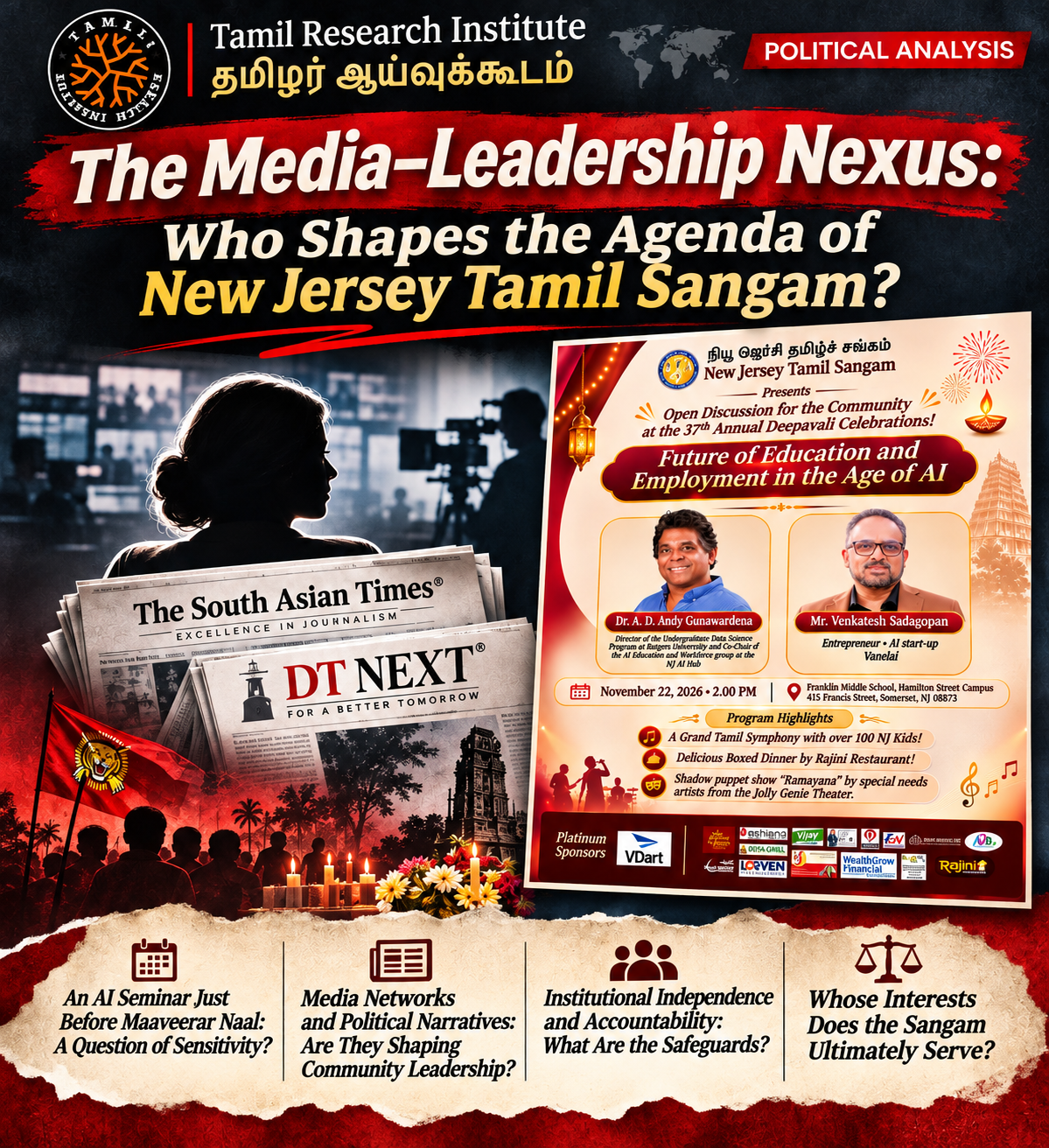
The Media–Leadership Nexus: Who Shapes the Agenda of New Jersey Tamil Sangam?
Historical Memory, Media Influence, and the Accountability of Tamil Diaspora Leadership
Arun Kumar , Tamil Research Institute (TRI) | Political Analysis | November 2026
The decision by New Jersey Tamil Sangam (NJTS) to organize an artificial intelligence seminar on November 22, 2026, just five days before Tamil Eelam Maaveerar Naal, raises serious questions about historical consciousness, institutional responsibility, and the independence of Tamil diaspora leadership.
The event features Dr. A. D. Andy Gunawardena, a Sri Lankan-origin academic, alongside another technology professional. Neither an AI seminar nor the participation of a Sinhalese academic is inherently objectionable. The concern is whether the Sangam adequately considered the historical significance of this period and meaningfully addressed objections from the Tamil community.
For an institution representing Tamils, historical sensitivity cannot be treated as an afterthought.
November: A Month of Remembrance November 27 marks Maaveerar Naal, observed by sections of the global Tamil diaspora in remembrance of those who died in the Tamil Eelam liberation struggle.
For families affected by Sri Lanka’s civil war, November carries profound historical and political significance. Allegations of mass atrocities, enforced disappearances, and unresolved demands for international accountability remain central to Tamil political consciousness.
Tamil institutions need not suspend educational activities during November. However, disregarding concerns about an event’s timing and context, if those concerns have been raised, would represent a serious failure of institutional judgment.
Our condemnation concerns institutional insensitivity—not academic exchange or an individual’s ethnicity.
Media Professionals in Tamil Leadership: A Question of Independence
Suchitra Srinivas, President of New Jersey Tamil Sangam, identifies herself on LinkedIn as an active media professional, including contributing editorial affiliations with The South Asian Times and DT Next.
Her professional background makes institutional accountability particularly important.
Media professionals operate within networks through which political narratives, diplomatic perspectives, and editorial priorities circulate. Such experience can strengthen community institutions, but it also makes transparent decision-making essential.
The concern is not that journalists should be excluded from Tamil organizations.
The concern is whether leaders with influential media connections can demonstrate that institutional decisions remain independent of external political narratives.
Professional affiliations alone do not establish improper influence. Nevertheless, Tamil diaspora communities should examine how decisions are made, how potential conflicts are managed, and whether community concerns receive meaningful consideration.
The South Asian Times, ANI, and Political Narratives
The published record of The South Asian Times provides a starting point for examining media framing.
On May 23, 2024, the newspaper reported on Sri Lanka’s relationship with India and its interest in joining BRICS, drawing upon an ANI interview with Sri Lankan Foreign Minister Ali Sabry.
On May 30, it published After India, Sri Lanka slams Canada for engaging in vote bank politics, reporting Sri Lanka’s opposition to Canada’s recognition of Tamil Genocide Remembrance Day.
The latter headline foregrounded Indian and Sri Lankan diplomatic objections rather than the underlying Tamil demands for historical recognition.
When Tamil accountability concerns are presented primarily through the objections of governments, whose perspective receives prominence?
These examples warrant scrutiny of the newspaper’s editorial framing. They do not establish that its overall coverage is anti-Tamil or that Srinivas authored, approved, or endorsed either report.
A broader quantitative assessment would be required to establish any systematic editorial pattern.
Indian Chronicles: The Geopolitics of Information
The 2020 Indian Chronicles investigation by EU DisinfoLab documented an international influence operation involving hundreds of websites and organizations.
The investigation examined how material associated with that network was amplified through ANI, illustrating how information ecosystems can shape international political narratives.
The South Asian Times has published ANI-sourced reporting. However, no verified evidence establishes its participation in Indian Chronicles or any involvement by Srinivas.
Nevertheless, the investigation offers an important lesson: diaspora institutions must understand how political narratives circulate through media networks and preserve independent institutional judgment.
That responsibility applies to every Tamil organization, irrespective of its leadership’s professional background.
Diaspora Surveillance and Institutional Responsibility
Sri Lankan state monitoring of Tamil political activism has been a documented concern in human rights and government reporting.
The United Kingdom’s August 2025 country information report on Tamil separatism addresses issues relevant to Tamil political activity and diaspora connections.
This history makes transparency concerning event registration, participant information, photography, and external institutional partnerships particularly important.
However, there is no verified evidence that the NJTS seminar was organized to identify Tamil activists or that its speakers were acting on behalf of Sri Lankan authorities.
Documented surveillance concerns justify vigilance and appropriate safeguards—not allegations based on ethnicity or professional association.
The Questions NJTS Must Answer
New Jersey Tamil Sangam’s leadership should clarify whether the historical significance of the remembrance period was considered, whether objections were formally reviewed, and what informed the decision to proceed.
It should also explain how speakers are selected, how participant information is protected, and how the organization ensures institutional independence.
These are reasonable expectations of any organization claiming to represent a diverse diaspora community.
If legitimate objections were raised and dismissed without meaningful engagement, that failure deserves unequivocal condemnation.
Tamil Identity Demands Institutional Accountability
Tamil organizations cannot build legitimacy through language, culture, and community representation while treating historical memory as an afterthought.
Nor should influential professional credentials shield community leaders from scrutiny.
The presence of media professionals in Tamil diaspora leadership makes transparent governance especially important, but it does not establish hidden political motives.
Tamil communities must scrutinize not merely who occupies leadership positions, but whose perspectives shape decisions, how institutional independence is protected, and whether community concerns are respected.
New Jersey Tamil Sangam owes its community clear answers.
Technological advancement cannot substitute for historical responsibility. A Tamil institution that claims to represent the community must remain accountable to its history, dignity, and collective concerns.
Arun Kumar
Tamil Research Institute (TRI)Political Analysis | November 2026


Comments ()