
From Strategic Asset to Strategic Scrutiny ? India’s Changing Image in the United States
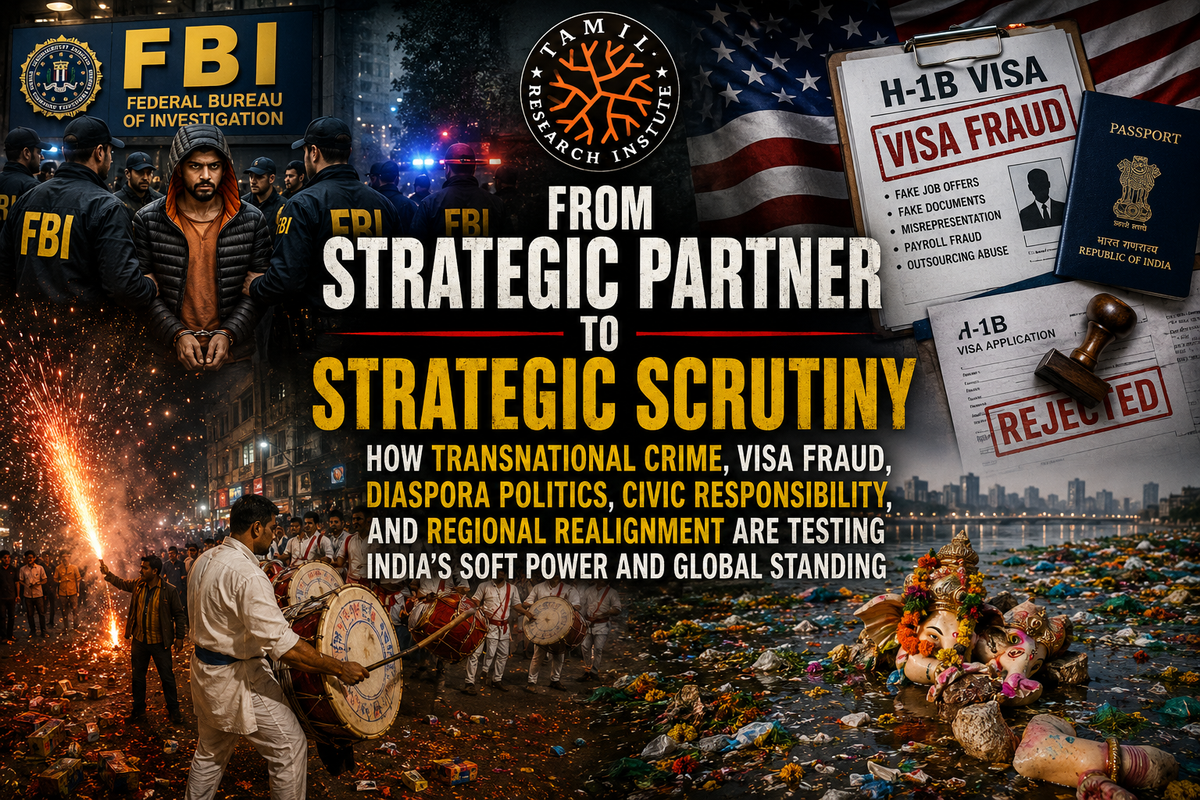
Transnational crime, cyber fraud, diaspora conduct and Pakistan’s diplomatic revival are testing India’s American soft power
By Arun Kumar, Geopolitical and Economic Analyst, Tamil Research Institute
For more than two decades, India’s rise appeared to align naturally with the strategic requirements of the United States. Washington viewed New Delhi as a democratic counterweight to China, a major technology and pharmaceutical partner, an increasingly capable military power, and the source of a highly skilled immigrant community that contributed significantly to American medicine, engineering, finance, academia and information technology.
That strategic foundation has not disappeared. India continues to matter to the United States, particularly in the Indo-Pacific and through its cooperation with the Quad. However, India’s value can no longer be assessed only through defense agreements, economic growth or competition with China.
American perceptions of India are increasingly being shaped by what happens inside the United States: criminal investigations involving India-based networks, alleged attempts to target political activists, cyber-enabled fraud directed at American citizens, immigration disputes involving outsourcing companies, and public controversies involving sections of the Indian diaspora.
None of these developments should be used to stereotype all Indians or Indian Americans. The overwhelming majority are peaceful, productive and law-abiding. Nevertheless, soft power is based on perception, and repeated controversies can gradually weaken the credibility accumulated by an entire community.
From Domestic Gang Violence to Transnational Organized Crime
The recent United States and Canadian crackdown on alleged networks associated with Lawrence Bishnoi represents an important change in how Indian organized crime is perceived internationally.
In July 2026, the U.S. Department of Justice announced charges arising from an international investigation into India-based organized crime networks. Federal prosecutors alleged racketeering, extortion, attempted extortion and narcotics-distribution conspiracies involving defendants associated with the Bishnoi network. These remain criminal allegations that must be proven in court, but their scale has transformed the issue from a domestic Indian gang problem into a North American security concern.
For American law enforcement, such cases are not viewed through the lens of Indian domestic politics. They are assessed as threats to American residents, businesses and public safety.
This distinction matters. India has traditionally projected its diaspora as a source of doctors, entrepreneurs, engineers and technology executives. When American media simultaneously begin associating India with extortion networks, contract violence, narcotics trafficking and intimidation, the country’s positive national brand becomes more complicated.
A few criminal actors cannot represent a community of millions. But public perception is rarely proportionate. Highly visible crimes often receive more attention than decades of ordinary professional contribution.
Transnational Repression and the Sovereignty Question
Even more damaging than organized crime are allegations that political dissidents and advocates living in democratic countries may be targeted because of their political positions.
In November 2023, U.S. prosecutors charged Indian national Nikhil Gupta in connection with a foiled plot to kill a U.S.-based Sikh separatist activist in New York. The Justice Department subsequently charged Indian government employee Vikash Yadav, alleging that he directed the murder-for-hire conspiracy. Gupta pleaded guilty in February 2026.
These proceedings concern specific defendants and allegations; they should not be generalized to Indian citizens or every institution of the Indian state. Nevertheless, the case carries enormous geopolitical consequences because it concerns an alleged assassination conspiracy on American territory.
For the United States, the question is larger than whether Washington agrees with the political objectives of Gurpatwant Singh Pannun or the Khalistan movement. The fundamental issue is whether a foreign power or foreign-linked network can intimidate, surveil or attack a person legally residing in the United States.
American constitutional protections do not depend on whether a foreign government considers an activist patriotic, separatist, extremist or offensive. Political expression that remains within American law is protected even when foreign governments strongly oppose it.
This principle is equally relevant to other communities advocating political rights and self-determination.
Tamil Activists and the Struggle for Justice and Accountability
Tamil diaspora activists in the United States, Canada, Britain, Europe and Australia have spent years campaigning for justice, accountability and political rights for Eelam Tamils affected by Sri Lanka’s civil war.
Their activities include documenting alleged wartime abuses, meeting elected representatives, supporting international accountability mechanisms, organizing remembrance events, advocating sanctions against alleged perpetrators and calling for political arrangements based on Tamil self-determination.
In 2024, a resolution introduced in the U.S. House of Representatives drew support from numerous Tamil diaspora organizations and brought renewed congressional attention to Tamil grievances, accountability and self-determination. Its legislative prospects were uncertain, but its introduction demonstrated the increasing political organization of the Tamil diaspora in the United States.
Tamil advocacy should not automatically be equated with militancy, terrorism or hostility toward any population. Peaceful campaigning for accountability, federalism, autonomy, a referendum or self-determination falls within democratic political discourse.
At the same time, Tamil activists and organizations remain subject to surveillance and suspicion in Sri Lanka. A 2025 British government country assessment stated that Sri Lanka continued to proscribe several Tamil diaspora organizations and that people associated with, or perceived to support, such groups could face surveillance, particularly when participating in demonstrations or online activism.
This is why allegations of transnational repression against Sikh, Tamil, Kashmiri or other political activists should concern all diaspora communities.
The political objectives of these movements are different, and they should not be treated as one unified cause. But they share a fundamental democratic expectation: individuals living in the United States should be able to advocate lawful political positions without fearing foreign intimidation or violence.
The credibility of the wider Indian diaspora will weaken if sections of the community appear to justify threats against activists merely because they disagree with their political demands. Diaspora influence should be built through democratic debate, evidence and civic participation—not through surveillance, intimidation or the importation of South Asian political conflicts into American neighborhoods.
Cyber Fraud and the Erosion of India’s Technology Brand
India’s international reputation has benefited enormously from its information-technology sector. Indian engineers, software professionals, technology entrepreneurs and cybersecurity experts have become central to the American economy.
But this achievement now exists beside another growing narrative: India-based call-center fraud and cyber-enabled scams targeting American citizens.
The FBI’s 2025 Internet Crime Report recorded nearly $21 billion in reported losses from cyber-enabled crime in the United States. The report also noted continuing cooperation with Indian law enforcement to investigate and disrupt fraudulent call centers.
In one major investigation disclosed in 2026, authorities connected three India-based call centers to a scheme that allegedly defrauded more than 650 American victims of over $48 million. The operators reportedly impersonated technology-support personnel and U.S. law-enforcement officers, manipulating victims into transferring money, cryptocurrency or gold. Indian authorities carried out raids and arrests with assistance connected to the American investigation.
Older Americans are particularly vulnerable to technology-support, government-impersonation and investment scams. When victims repeatedly encounter fraudsters using Indian call centers, accents or technology-service identities, their experience can unfairly shape attitudes toward legitimate Indian professionals and businesses.
This represents a serious soft-power contradiction.
India wants to be recognized as a trusted center for digital transformation, financial technology, artificial intelligence and cybersecurity. But that image is undermined whenever criminal enterprises operating from India systematically exploit the same technology and telecommunications infrastructure to defraud foreign citizens.
The answer is not to stigmatize Indian workers or call centers. India itself has millions of cybercrime victims, and Indian authorities have cooperated in international enforcement actions. The appropriate response is stronger regulation, rapid prosecution, financial-intelligence cooperation, telecommunications controls and serious action against officials who protect illegal call-center operations.
India cannot simultaneously market itself as a global digital leader while appearing unable—or unwilling—to dismantle criminal digital ecosystems operating within its territory.
H-1B Visas, Outsourcing and the Limits of Economic Goodwill
Indian professionals have been among the largest beneficiaries of the H-1B visa and employment-based immigration system. Their contributions to technology, healthcare, finance, research and engineering are substantial.
However, the American political environment surrounding skilled immigration has changed.
H-1B debates increasingly focus on whether companies use the program to address genuine skills shortages or to lower labor costs, replace American employees and transfer work to offshore delivery centers. Large outsourcing companies attract particular scrutiny because their business models can be portrayed as benefiting from American immigration access while gradually moving American jobs abroad.
India’s employment-based green-card backlog is also producing a difficult political contradiction. Many Indian professionals spend decades working, paying taxes and raising American-born children while remaining tied to temporary visa classifications. Yet broader immigration restrictions and labor-market anxieties make comprehensive reform increasingly difficult.
Cyber fraud, transnational crime and alleged political intimidation are legally unrelated to H-1B policy. They should not be deliberately conflated. Nevertheless, political narratives frequently merge unrelated concerns.
Once a country’s image becomes associated with outsourcing, visa dependency, call-center fraud and foreign political influence, even law-abiding skilled workers can become indirect victims of reputational decline.
Cultural Expression and Civic Responsibility
America’s multicultural system allows immigrant communities to preserve and publicly celebrate their religious and cultural identities. Diwali programs, Garba dances and Ganesh Chaturthi festivals can contribute positively to American cultural life.
But religious freedom does not create an exemption from civic responsibility. Ganesh processions involving powerful drums and amplified music, Garba events continuing late at night in residential areas, disruptive street gatherings, unregulated fireworks and traffic obstruction can irritate neighbors who have no involvement in the celebration.
The issue is not whether Hindu festivals belong in America. They do. The issue is whether organizers adapt their celebrations to American rules governing noise, permits, traffic, public safety and shared spaces.
A permitted festival conducted at a community center, temple, commercial venue or designated public location is entirely different from repeatedly imposing high-volume music, drums or fireworks on residential neighborhoods.
The same standard should apply to every religion and community. A church, mosque, temple, political organization or entertainment venue should not be allowed to create unreasonable disruption merely by describing an event as a cultural or religious activity.
Ganesh idol immersion also creates a legitimate environmental issue. Natural clay and biodegradable materials differ substantially from plaster of Paris, plastics, artificial decorations and chemically painted idols. Immersion of non-biodegradable or chemically treated materials can introduce waste and contaminants into lakes and waterways.
Practices increasingly questioned or regulated on environmental grounds within India should not be exported uncritically to American public waters. Symbolic immersion, reusable idols, natural clay, household containers and specially created artificial tanks can preserve religious meaning without transferring environmental costs to the wider community.
This adaptation is not cultural surrender. It is responsible citizenship.
A successful diaspora does not merely recreate the public practices of its country of origin. It preserves cultural meaning while respecting the legal, environmental and civic expectations of its adopted society.
The 2025 India–Pakistan Escalation
These diaspora and reputational pressures are emerging at a moment when the strategic balance in South Asia is also becoming more fluid.
The May 2025 India–Pakistan confrontation represented one of the most serious military crises between the nuclear-armed neighbors in recent years. It involved airstrikes, missiles, drones, cross-border fire and cyber operations before de-escalation occurred. Analysts warned that future crises could intensify because both sides demonstrated a willingness to cross previous military thresholds.
India entered the confrontation with greater economic, military and diplomatic weight. However, the crisis also returned Pakistan to the center of international diplomacy.
Every India–Pakistan confrontation forces Washington, Beijing, Gulf capitals and other powers to engage Islamabad because Pakistan remains a nuclear-armed state whose stability directly affects Afghanistan, China, Iran, the Arabian Sea and the broader Muslim world.
Therefore, even when Pakistan is economically weaker than India, its geopolitical relevance cannot be measured through GDP alone.
The 2025 crisis did not establish that Pakistan had strategically defeated or replaced India. But it reminded international actors that Pakistan remains capable of influencing regional escalation, airpower calculations, nuclear risk and South Asian crisis management.
The 2026 U.S.–Iran Conflict and Pakistan’s Diplomatic Return
Pakistan’s geopolitical relevance increased further during the 2026 conflict involving the United States and Iran.
Pakistan occupies a strategically important location. It shares a long border with Iran, maintains relations with China and the Gulf states, has security connections with the United States, and possesses influence across the wider Muslim world.
During the conflict, Pakistan attempted to maintain channels with both Washington and Tehran. Pakistani mediation contributed to a preliminary U.S.–Iran agreement in June 2026, with Qatar also playing an important supporting role after negotiations became difficult. Reuters reported that Pakistan’s involvement generated diplomatic recognition and could potentially yield economic benefits, although the country’s underlying economic weaknesses remained unresolved.
When fighting renewed in July 2026, Pakistan remained among the regional states pressing for de-escalation and the restoration of negotiations.
This represented more than a temporary diplomatic success. It allowed Islamabad to present itself as a state capable of communicating across otherwise hostile political blocs.
Pakistan has relationships with Iran, Saudi Arabia, China, Turkey, Qatar and the United States. Its geography connects South Asia, Central Asia and West Asia. These characteristics can make it useful during crises even when its domestic economy remains fragile.
By contrast, India’s strategic posture is more strongly concentrated on the Indo-Pacific, China and economic partnerships with Western states. New Delhi remains important, but Pakistan’s mediation during the Iran conflict demonstrated that Washington’s South Asian relationships are not necessarily a zero-sum choice.
America can maintain a strategic partnership with India while simultaneously rebuilding tactical cooperation with Pakistan.
Is South Asia Shifting Toward Pakistan?
It would be premature to claim that the United States has abandoned India in favor of Pakistan.
India retains significant advantages: a much larger economy, a vast consumer market, advanced technology industries, growing naval capacity, defense cooperation with the United States and its partners, and a central role in balancing China in the Indo-Pacific.
The more accurate conclusion is that Pakistan has recovered tactical geopolitical relevance, while India continues to possess greater structural strategic importance.
The danger for India is that this gap could narrow. Pakistan’s diplomatic usefulness may rise when the United States requires mediation involving Iran, Afghanistan, China or the Muslim world. At the same time, India’s political capital could decline if its international image becomes increasingly associated with transnational repression allegations, organized crime, cyber fraud, contentious diaspora nationalism and immigration controversies.
Geopolitics is not determined only by military strength. It is also shaped by utility, timing, access, credibility and the ability to communicate with adversarial states.
India remains valuable because of China. Pakistan becomes valuable whenever crises emerge across Iran, Afghanistan, the Gulf or the wider Islamic world.
Washington therefore has reasons to engage both countries for different purposes.
The Diaspora as India’s Greatest Asset—and Potential Vulnerability
For decades, Indian Americans functioned as one of India’s greatest diplomatic advantages. Their success generated goodwill that no embassy or lobbying contract could easily reproduce.
Indian-origin doctors treated American patients. Engineers built technology systems. Entrepreneurs created companies. Academics led research institutions. Public officials entered local, state and national politics.
But diaspora influence depends on credibility.
That credibility can weaken when public religious expression is conducted without civic sensitivity, when aggressive nationalist politics attempts to silence minority voices, when foreign conflicts are imported into American communities, or when criminal investigations create doubts about cross-border political and financial networks.
Tamil, Sikh, Kashmiri, Dalit, Christian, Muslim, Hindu and other South Asian voices must all be able to participate in American public life without intimidation. Indian diaspora organizations cannot claim democratic influence in Washington while rejecting democratic pluralism within their own communities.
The diaspora will retain credibility only when it rejects organized crime, cyber fraud, caste and religious intimidation, and violence against political opponents—regardless of the identity of the alleged perpetrator or victim.
India’s Strategic Problem Is Accumulation
No single Ganesh procession will damage India–U.S. relations.
No single cybercrime network will erase the contributions of Indian technology professionals.
No single criminal indictment will define a nation of more than a billion people.
No single immigration dispute will end the strategic partnership between Washington and New Delhi.
The danger arises through accumulation.
When American citizens repeatedly encounter stories about call-center fraud, visa abuse, gang violence, alleged assassination plots, aggressive diaspora politics and disruptive public conduct, these separate incidents can begin forming a wider negative narrative.
That narrative may not be entirely fair, but international politics is influenced by perception as much as by objective measurement.
India’s challenge is therefore not simply to deny criticism or accuse every critic of hostility. It must demonstrate that it can investigate criminality, cooperate with foreign judicial institutions, respect political dissent, regulate cyber-fraud networks and encourage responsible diaspora leadership.
Conclusion: Hard Power Cannot Permanently Compensate for Declining Trust
India remains an important American partner. Its economic scale, geographic position, technological capacity and role in balancing China ensure that it will not become strategically irrelevant.
But importance is not the same as indispensability.
The 2025 India–Pakistan escalation and Pakistan’s diplomatic role during the 2026 U.S.–Iran conflict demonstrate that South Asian geopolitics is becoming more competitive and multidirectional.
Pakistan has regained a degree of diplomatic utility. Gulf states, Southeast Asian economies and other Indo-Pacific partners are expanding their strategic roles. The United States has more options than it did two decades ago.
India must therefore protect the asset that originally distinguished it from many competitors: democratic legitimacy, professional credibility and diaspora soft power.
This requires firm action against organized crime and cyber fraud. It requires transparency regarding alleged transnational repression. It requires recognition that Sikh, Tamil, Kashmiri and other activists have the right to engage in lawful political advocacy within democratic countries. It also requires diaspora organizations to celebrate religion and culture in ways that respect neighbors, environmental protections and local law.
The greatest threat to India’s influence in America is not Pakistan alone, nor China alone, nor anti-Indian prejudice.
It is the possibility that India’s hard power will continue growing while international trust in its political conduct and diaspora credibility gradually declines.
Strategic influence is difficult to build but easy to weaken. India’s future standing in the United States will depend not merely on how powerful it becomes, but on whether that power is considered responsible, democratic and trustworthy.

Comments ()