
Beyond the NEET Controversy: The Delhi Protests Are a Constitutional Opportunity for Tamils to Reimagine State Autonomy
A TRI Public Policy Analysis by Arun Kumar R
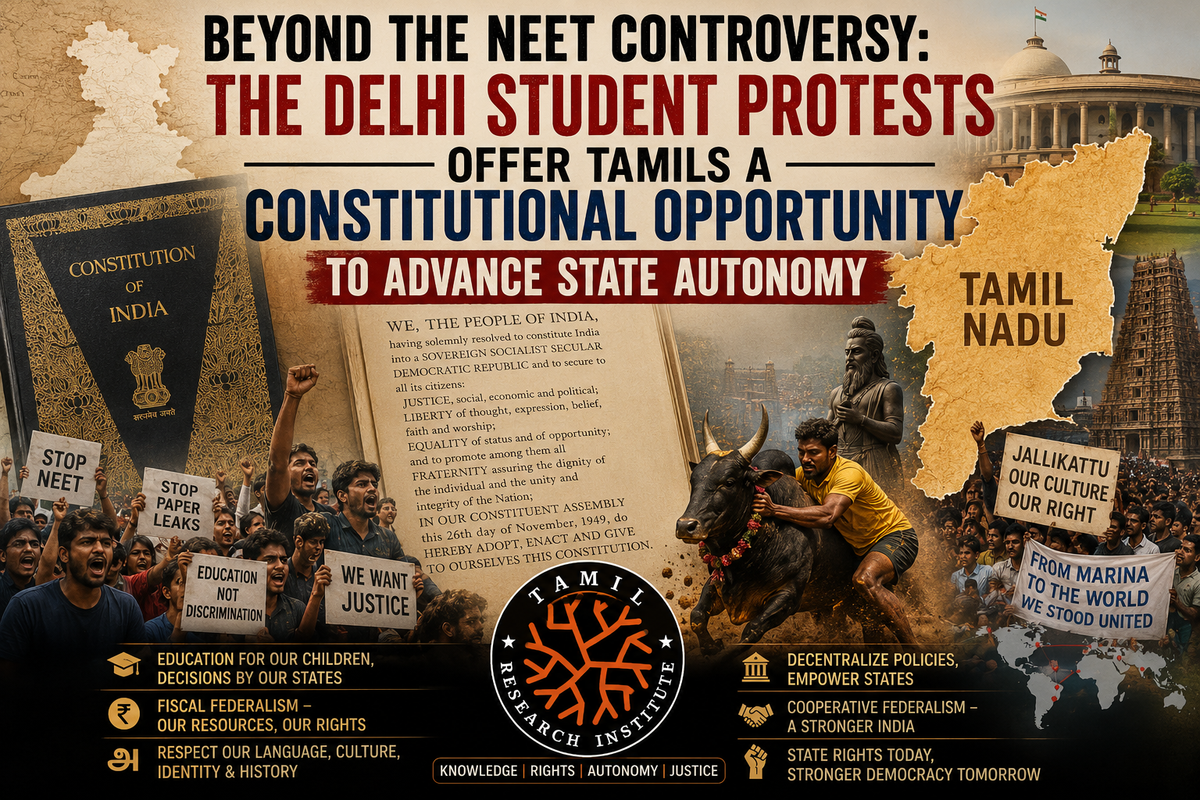
The ongoing student protests in New Delhi are widely portrayed as a response to the NEET controversy and demands for education reforms. While these immediate concerns are legitimate, students and civil society in Tamil Nadu should recognize that this moment presents a much broader constitutional opportunity.
For over a decade, Tamil Nadu has consistently argued that many national policies are becoming increasingly centralized, reducing the policy-making space available to states. The debates over NEET, the National Education Policy (NEP), GST, language policy, fiscal federalism, river water disputes, and even aspects of India’s foreign policy affecting Sri Lankan Tamils all reflect a common constitutional question:
How much authority should India’s States retain within a federal Union?
The Delhi protests should therefore not be viewed merely as another NEET controversy. They should be understood as part of a larger national conversation about governance, democratic accountability, and the balance of powers between the Union Government and the States.
The Lesson from Jallikattu
Tamil Nadu has already experienced how a single issue can evolve into a broader constitutional movement.
The 2017 Jallikattu protests began as a campaign to restore a traditional Tamil cultural practice. Within days, the movement united millions of Tamils across Tamil Nadu and the global diaspora. Demonstrations took place not only throughout the state but also in the United States, Canada, the United Kingdom, Australia, Europe, Malaysia, Singapore, Sri Lanka, and the Middle East.
The immediate objective was to restore Jallikattu.
However, the movement evolved into something much larger.
For many participants, Jallikattu became a symbol of protecting the constitutional rights of a State to preserve its own culture, identity, traditions, and public policies without excessive central intervention. Public discussions soon expanded beyond cultural rights to include education, language, taxation, natural resources, and the constitutional distribution of powers.
For some political movements and activists, these debates further developed into demands for greater State autonomy and, in some cases, advocacy for the principle of Tamil self-determination. These represented the views of particular groups rather than the universally stated objectives of the protests themselves, but they illustrate how constitutional debates can broaden as movements evolve.
Why Tamil Nadu Should Not Miss This Moment
The Delhi protests demonstrate that concerns about centralized governance are no longer confined to Tamil Nadu.
Students across India are questioning how national institutions are governed, how decisions are made, and whether centralized systems remain sufficiently accountable.
Tamil Nadu should seize this opportunity to broaden the national conversation beyond examination reforms alone.
Instead of limiting public discourse to NEET, policymakers, academics, students, and civil society should also advance proposals on:
- Greater decentralization of education policy.
- Increased fiscal autonomy for States.
- Constitutional reforms that strengthen cooperative federalism.
- Expanded State participation in national policy decisions.
- Protection of linguistic and cultural diversity.
- Stronger institutional mechanisms for Centre–State consultation.
A Constitutional Debate, Not Merely an Education Debate
India’s diversity requires governance structures capable of accommodating different educational systems, economic priorities, cultural traditions, and regional aspirations.
The central question is therefore not simply whether NEET should be reformed.
It is whether India’s federal democracy should evolve toward greater constitutional decentralization, enabling States to exercise meaningful authority over matters that directly affect their people while remaining integral partners within the Union.
TRI Assessment
History shows that major constitutional debates often begin with a single public grievance.
Jallikattu began as a cultural movement but opened a wider discussion on State rights.
Today’s Delhi student protests may similarly become remembered not only as a protest against examination failures but also as a catalyst for re-examining India’s federal structure.
For Tamil Nadu, the strategic objective should not be limited to opposing one examination or one policy. The larger opportunity is to advocate for a constitutional framework that strengthens federalism, expands State autonomy, deepens democratic accountability, and ensures that India’s unity is reinforced through respect for its diversity.


Comments ()